





More and more companies are turning to external providers for IT support. This approach helps them scale faster, cut costs, and improve infrastructure reliability. In this article, we explore why businesses need MSPs, how to choose the right partner, and what to consider when transitioning to a new support model.
How External IT Support Helps Companies Scale and Reduce Risk
Today, many organizations are seriously considering outsourcing part or all of their IT infrastructure support to third-party service providers. This decision can enhance system reliability, reduce costs, and make business operations more flexible.
But how do you choose the right partner? Why has this step become optimal in the current “new normal”? And how can you build trust with a team that operates outside your office?
Why Companies Are Switching to External Support
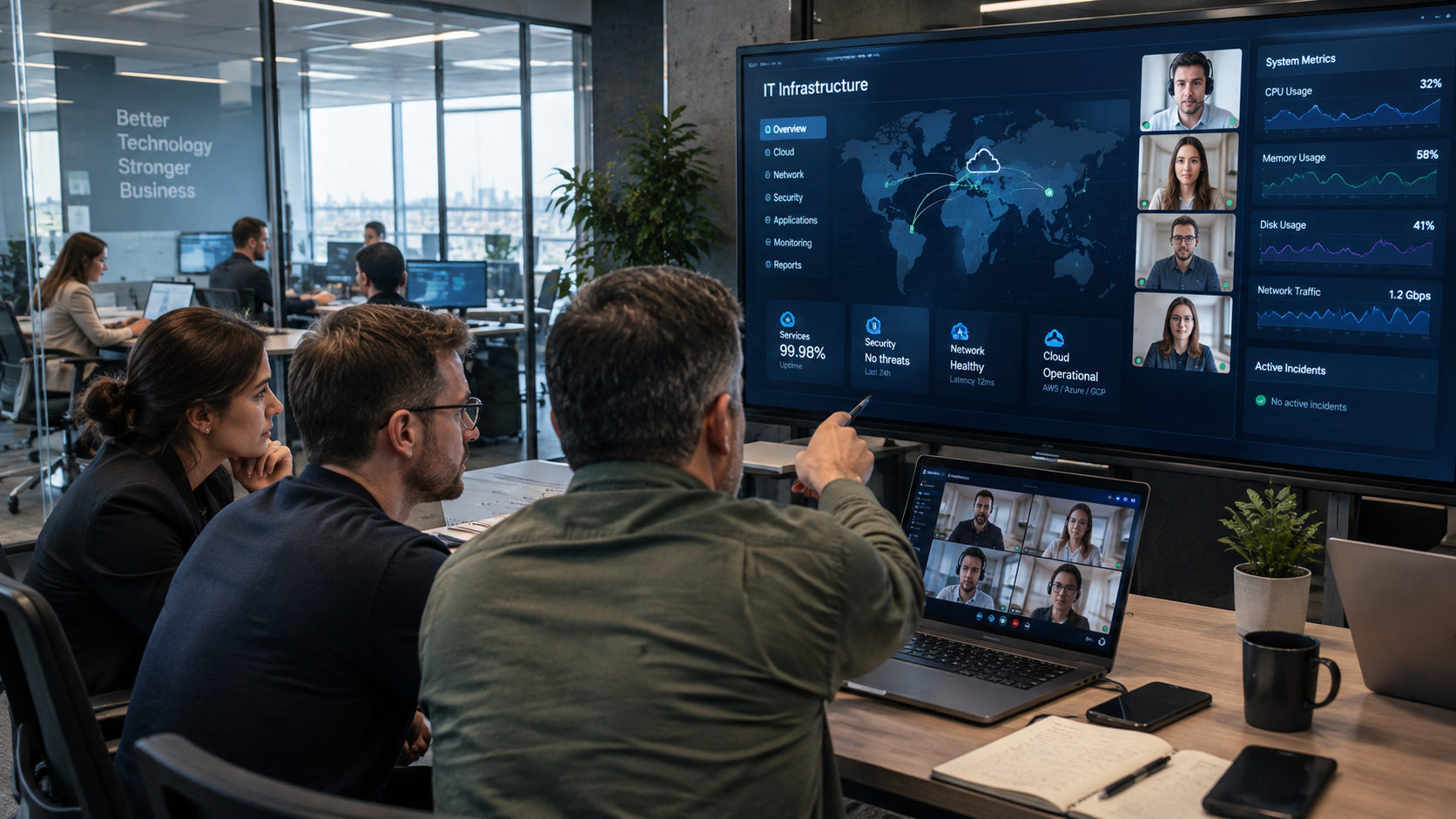
The result is clear: the demand for external technological expertise has grown significantly. The requirements for system availability, security, and efficiency have become much higher. This has accelerated the global trend toward outsourcing IT support.
Globally, two main models have emerged:
- Managed Service Providers (MSP): An external provider handles part of the IT responsibilities, complementing the in-house team.
- Full Outsourcing: The entire infrastructure is managed by an external partner.
In Ukraine, both models are still less common than abroad, but demand is rising. This is especially true in industries where even a brief service outage can lead to direct financial losses — for example, in e-commerce.
At the same time, it’s increasingly difficult to maintain round-the-clock, high-quality support using only internal resources: systems are becoming more complex, uptime and security expectations are growing, and training high-level specialists takes years.
The New Reality and the Role of MSPs
As hybrid work becomes the standard, IT environments are becoming more complex. This increases the value of MSPs — partners who can respond quickly to business needs and deliver high-quality service without requiring companies to expand their internal teams.
In this article, we’ll break down how outsourced technical support works in practice, what benefits it provides, what to look for when choosing a partner, and which mistakes to avoid.
A Model Built on Trust and Partnership
Co-managed IT systems are, first and foremost, about long-term partnership. They are built on mutual trust: the provider is aligned with the client’s goals and becomes an organic part of the team.
If the company already has an internal IT department, an MSP can step in as an additional source of expertise, resources, and scalability. Tasks may include:
- End-user technical support
- Network and security system administration
- Infrastructure and device monitoring
- Support and development of corporate software (e.g., Office 365)
- Assistance in digital transformation projects
The collaboration format is flexible — from on-site presence to remote monitoring, strategic consulting, or staff training.
This kind of partnership helps businesses address IT needs faster, without wasting time on hiring and onboarding. It’s especially valuable when niche expertise is required — for example, in cybersecurity or during cloud migration.
According to Canalys, the main reasons companies shift to co-managed IT models are:
- Increasing infrastructure complexity (33%)
- The need to optimize IT costs (29%)
Meanwhile, the chronic shortage of qualified IT professionals only reinforces the demand for MSP services.
The Pandemic Accelerated the Shift Toward External IT Support
Although the term co-managed IT appeared relatively recently, the concept itself is not new. In the United Kingdom, for example, companies, government agencies, and healthcare institutions began outsourcing parts of their IT infrastructure as far back as the 2009 economic crisis.
However, over the past few years, global demand for such services has grown dramatically. One of the key factors was the massive and unexpected transition to remote work during the first lockdown. In the United States, companies with 150 to 1,000 users are increasingly turning to MSPs, and this trend is steadily spreading to other regions.
The hybrid work model forces organizations to seek new solutions, and partnering with an external provider allows them to accelerate digital transformation while maintaining cost control through the as-a-service model.
How to Transition to External IT Support and Choose a Reliable Provider
Every IT infrastructure includes services that require instant response in critical situations, as well as those demanding highly skilled administrators to maintain efficiency. Problems in these areas inevitably start to affect the business directly: processes slow down, and executives must spend valuable time resolving technical issues or negotiating with vendors.
That’s why collaboration with an MSP is often seen as a way to increase operational efficiency and accelerate growth. However, before delegating part of your IT functions to an external partner, it’s important to weigh all pros and cons.
For instance, if your top priority is the uninterrupted operation of mission-critical systems, you can arrange round-the-clock provider support for them while keeping other services in-house or engaging the MSP on demand — without an SLA on response time.
Companies that fully outsource their IT support value reliability, responsiveness, and deep business understanding in their partners. Such a provider effectively becomes an extension of the internal team, earning the same level of trust as in-house employees.
Key Criteria for Choosing an IT Provider

Instead of hiring a single IT manager, the business gains access to a team of professionals with broad expertise, paying only for the services actually rendered. This model provides access to specialized skills, enables rapid solution scaling, and allows complex challenges to be solved without overloading internal resources.
For example, setting up new functionality or scaling infrastructure might take internal teams weeks, but an experienced MSP has already perfected these processes. They understand potential pitfalls and can complete the work faster and more efficiently.
A reliable IT provider removes the routine burden from the business, allowing teams to focus on growth and innovation. Ambitious companies seek forward-thinking partners who are ready to build long-term relationships.
Unlike one-time “firefighting” interventions, modern IT outsourcing is a full-fledged management model that includes strategic planning, new solution implementation, and continuous infrastructure support over the long term.
Key Considerations
Effective communication is the cornerstone of a successful transition to structured cooperation with an IT provider. From the outset, both parties must align on partnership terms: division of responsibilities, working hours, and designated points of contact.
Setting clear expectations early significantly reduces the risk of misunderstandings and instability later on. For example, if the provider performs most work outside your company’s business hours, it helps minimize downtime and avoid disrupting staff.
It’s equally important to appoint account managers and key representatives on both sides. This enables the provider to gain deeper insight into your business and function as a true extension of your internal team.
When signing the agreement, organize a kick-off meeting between the external and internal IT teams. This facilitates knowledge transfer — including the current infrastructure status, pending tasks, and ongoing projects. It's also essential to define the boundaries of responsibility and the level of autonomy for each side, which increases overall efficiency and reduces delays.
However, collaboration doesn’t end at contract signing. Like any transition, unexpected challenges may arise, so it’s best to conduct regular feedback sessions.
The simplest approach is a weekly call with the account manager to review completed work, future plans, and any potential issues. These meetings help resolve small concerns before they escalate, maintain alignment, and reduce operational risks.
Conclusion
If your company requires ongoing or partial support for IT systems and services, we offer our Technical Support service. For over 15 years, our engineering team has delivered infrastructure solutions that ensure stable operation of IT tools and business applications for companies of all sizes.
Today, we support:
- 20+ clients under technical support agreements
- 1000+ average users per client
- 35+ long-term partners
- 60+ projects annually
- 98% customer satisfaction rate
- 50+ vendor partnerships
By activating our Technical Support service, you gain not just a reliable partner — but a dedicated external team of skilled engineers, ready to respond to complex incidents quickly and help you realize your most ambitious plans.