





Modern IT infrastructure forms the foundation of a stable and scalable digital ecosystem. Its quality directly impacts data security, process efficiency, and the speed of launching new services. Hybrid models and virtualization provide businesses with the flexibility and resilience needed to adapt to constant change.
How a Well-Built Infrastructure Accelerates Business Growth
In today’s world, where digital technologies evolve at an unprecedented pace, IT infrastructure has become one of the most strategic assets for any business. It is no longer just a set of servers and networking equipment—it’s the backbone that supports the stability, performance, and security of an entire organization.
The Industrie 4.0 trend implies deep integration of automation, artificial intelligence, the Internet of Things (IoT), Big Data, and cloud technologies into production and management processes. In such an environment, a business’s ability to quickly process data, protect information, and respond flexibly to new challenges depends entirely on the reliability of its IT infrastructure.
According to Gartner, the global IT infrastructure market surpassed $1.6 trillion in 2024. In the EU and Ukraine, digitalization investments are growing at a rate of 12–15% annually. The reason is clear: even one hour of downtime for critical systems can cost a large company hundreds of thousands of dollars.
For example, a major Ukrainian e-commerce platform migrated its core services to a hybrid cloud in 2023. As a result, infrastructure costs were reduced by nearly a third, and order processing speeds during peak demand increased by 45%.
What Is IT Infrastructure?
IT infrastructure is an integrated system of hardware, software, and networking resources that ensures uninterrupted operation of digital services and supports core business processes.
If you imagine a company as a living organism, IT infrastructure acts as its nervous system—connecting all departments, transmitting signals, and coordinating the functioning of every "organ." For a small business, it might be a simple set of office computers, a few cloud services, and a router. For a global enterprise, it could involve a network of data centers, virtualized platforms, secure communication channels, and advanced data storage systems.
Modern technologies allow these components to be unified into a single, seamless ecosystem, where all services interact without disruption. This level of integration enables fast deployment of new solutions, resource scalability, and strong cybersecurity.
Key Components of IT Infrastructure
- Hardware: Servers, workstations, storage systems, networking devices
- Software: Operating systems, ERP/CRM platforms, cybersecurity tools, analytics software
- Networking: Routers, switches, firewalls, VPNs, cloud connectivity
Key Goals and Objectives of IT Infrastructure
A well-designed IT infrastructure not only supports a company’s daily operations but also creates a foundation for sustainable growth. Its primary goal is to ensure availability of corporate services for all user groups — including employees, customers, and partners. In a world where response speed determines success, uninterrupted business processes are a critical factor.
Equally important is data protection — from cyberattacks to internal threats. Modern systems must be flexible enough to scale seamlessly to meet new business needs. Efficient resource management and cost optimization help companies increase productivity while keeping operating expenses under control.
Example from Ukraine: A national logistics operator implemented a centralized IT resource monitoring system. As a result, incident response time dropped by 60%, and over 20 critical failures were prevented in just one year — directly improving delivery speed and customer satisfaction.
Structure and Types of IT Infrastructure: Core Components and Application
An enterprise IT infrastructure is built on three fundamental layers — hardware, software solutions, and network infrastructure. Each plays a distinct role, and together they form an integrated ecosystem that supports the operation of all digital services.
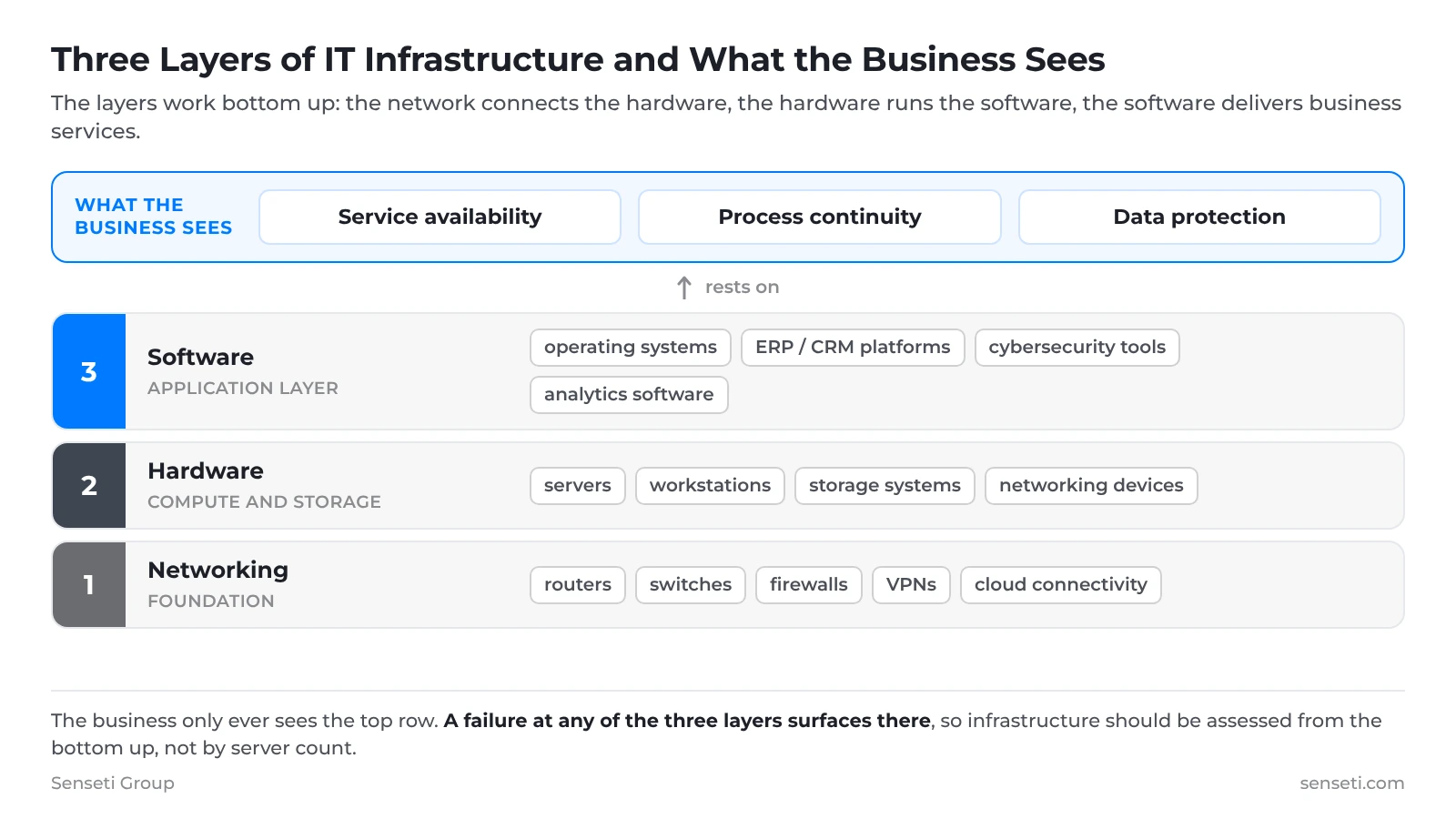
The network connects the hardware, the hardware runs the software, and the business only ever sees the top row.
- Hardware is the physical foundation of the system. This includes servers, storage systems (SAN/NAS), workstations and laptops, networking equipment, uninterruptible power supplies (UPS), and engineering systems such as cooling, ventilation, and power supply. Without these components, reliable operation of software and services is not possible.
- Software manages the hardware and enables business functionality. This encompasses operating systems, ERP and CRM platforms, cybersecurity systems, virtualization tools, analytics software, corporate email, and collaboration platforms.
- Network infrastructure links all elements together. Routers, switches, VPN gateways, firewalls, and traffic management systems are responsible for data transmission, secure access, and connection stability.
Vendor examples: Cisco, HP, Dell Technologies, Microsoft, VMware, Fortinet
Trending technologies being actively implemented:
- SD-WAN for optimizing network routing
- Zero Trust Security for multilayered data protection
Depending on where resources are hosted and how services are managed, IT infrastructure typically falls into three main types, each with its own strengths and limitations:
- On-premises (Local) – All servers and equipment are located within the company’s premises, typically in private data centers. This approach offers complete control over data and configurations but requires high capital (CAPEX) and ongoing operational costs (OPEX).
- Cloud – Resources are leased from a provider and accessed via the internet. This model offers flexibility, fast deployment and scaling, and reduces budget strain by shifting from CAPEX to OPEX. However, responsibility for uptime and security is partially transferred to the provider.
- Hybrid – Combines on-premises resources with cloud services. It allows businesses to maintain control and security for critical data while scaling dynamically in the cloud to handle variable workloads.
Comparison Table:
| Infrastructure Type | Advantages | Disadvantages |
| On-premises | Full control, high security, independence from external providers | High CAPEX and OPEX, limited scalability |
| Cloud | Fast scalability, cost savings, access from anywhere | Dependency on provider, requires strong internet connectivity |
| Hybrid | Balance of control and flexibility, cost optimization | More complex administration, need for system synchronization |
Cloud providers: AWS, Microsoft Azure, Google Cloud, Hetzner.
Building and Assessing IT Infrastructure: Key Stages and Performance Indicators
Developing an IT infrastructure is a complex process that requires a clear strategy and involvement of specialists from various fields. The stability of the entire system depends on the quality of execution at each stage.
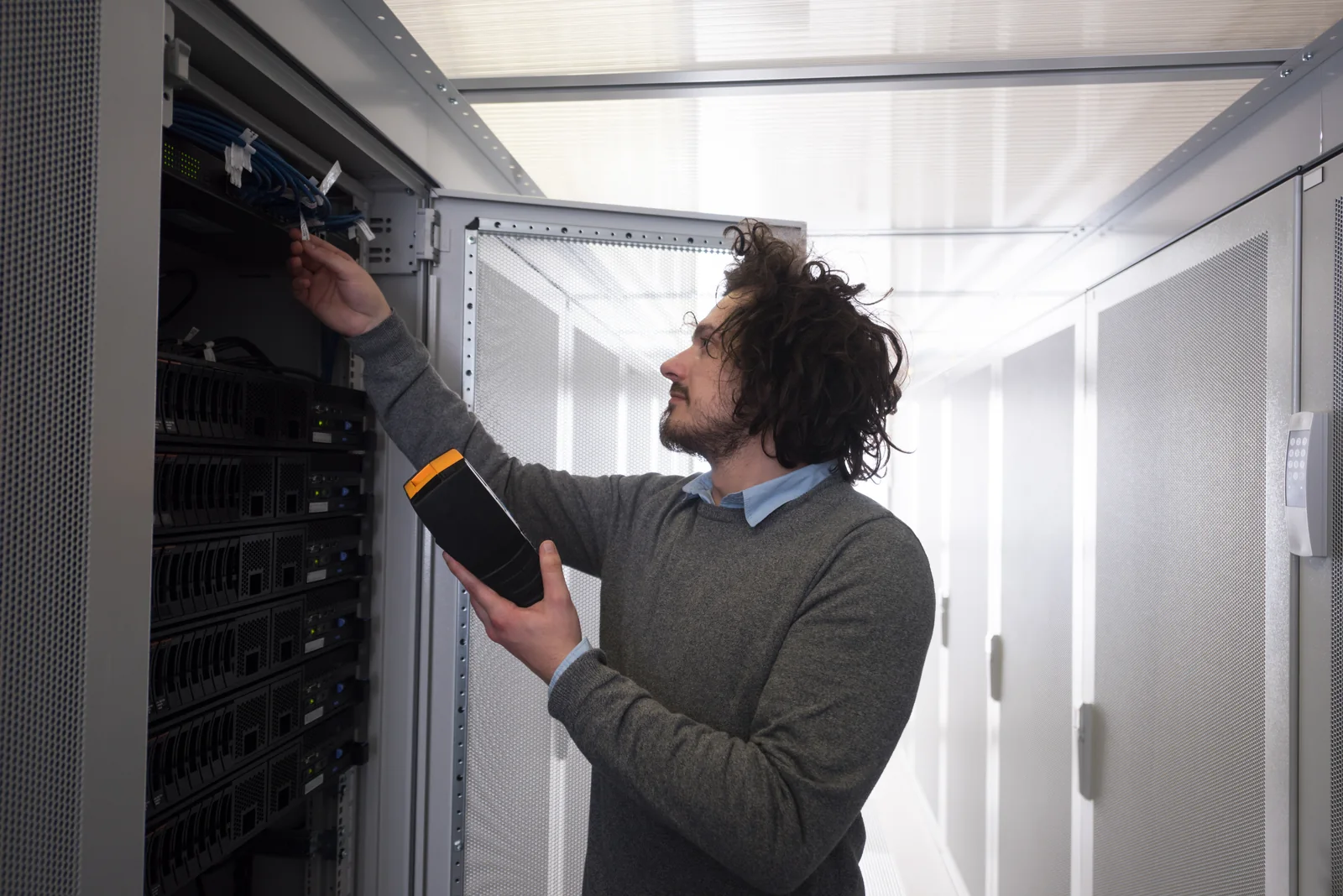
Assessing infrastructure means measuring it with an instrument, not taking the provider's word for it.
Step-by-step process:
- Audit and requirements gathering
- Specialists begin by analyzing the current infrastructure, identifying bottlenecks, and defining the business goals. This forms a clear understanding of what the new system must achieve.
- Technical specification (ToR) development
- This document outlines functional requirements, architecture, deadlines, security measures, and scalability needs.
- Solution and vendor selection
- A critical phase where vendors, hardware models, software platforms, and services are chosen to meet the budget and business objectives.
- Pilot deployment
- Before large-scale implementation, a limited rollout is conducted to identify potential issues and fine-tune configurations.
- Integration and configuration
- After the pilot is approved, all components are deployed — servers, networking gear, and software solutions — and integrated with existing systems.
- Testing
- Verifies that the infrastructure operates reliably and supports all business processes smoothly. Incident response plans are also developed during this stage.
- Staff training and documentation handover
- Employees receive operational instructions, while the client receives complete system architecture documentation and an SLA (Service Level Agreement) defining system standards and response times.
The role of system integrators is critical at this stage — they bring technical expertise, coordinate project stakeholders, and minimize risks during implementation.
Key Criteria for Evaluating IT Infrastructure Quality
To measure how effectively an IT infrastructure performs, businesses rely on several core criteria:
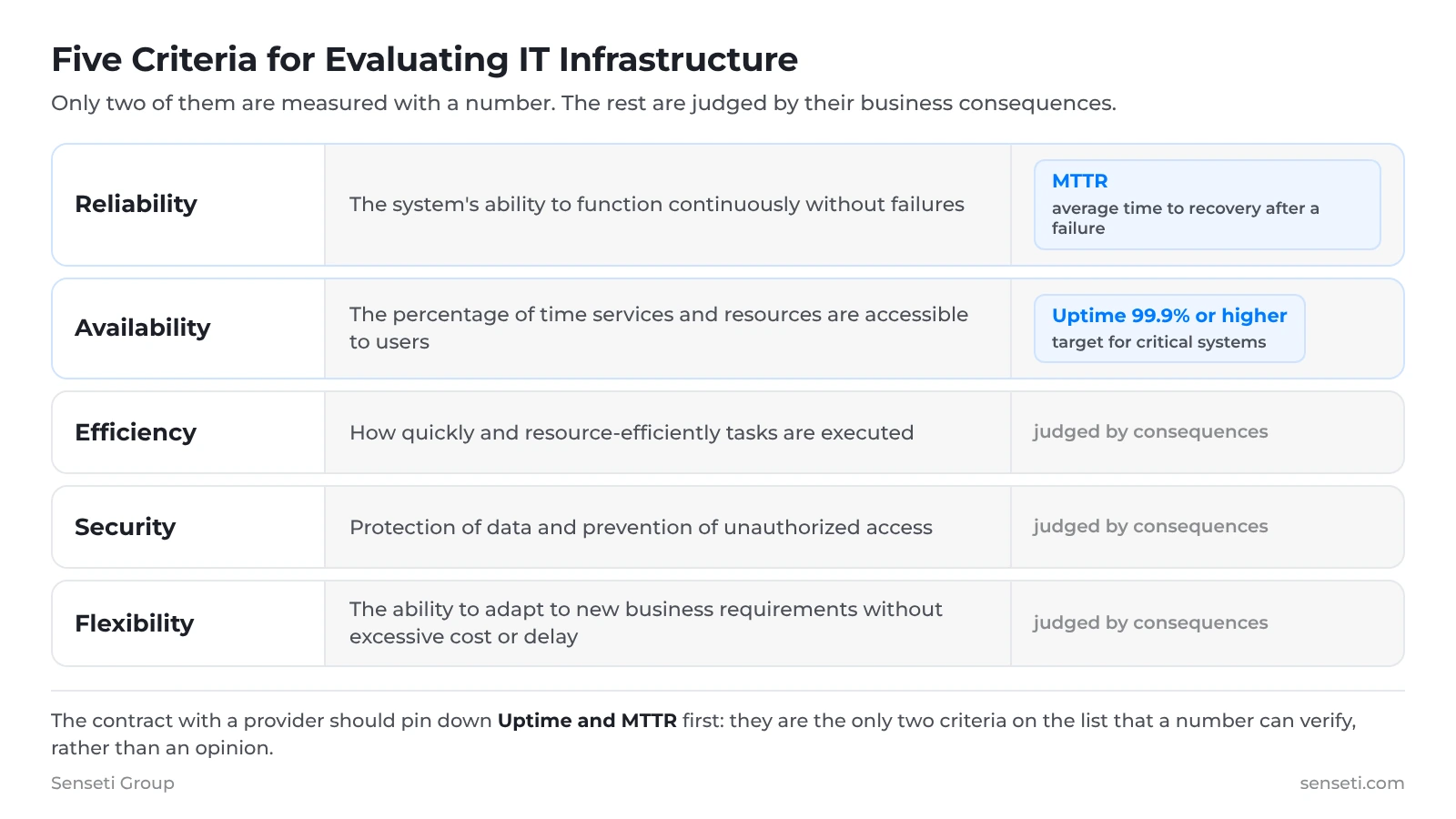
Only two criteria can be verified with a number, so those are the ones worth putting into the contract.
- Reliability – The system’s ability to function continuously without failures.
- Availability – The percentage of time services and resources are accessible to users (typically tracked in SLAs).
- Efficiency – How quickly and resource-efficiently tasks are executed.
- Security – Protection of data and prevention of unauthorized access.
- Flexibility – The ability to adapt to new business requirements without excessive cost or delay.
Common infrastructure performance metrics:
- Uptime (%) – Percentage of time the system is fully operational (target for critical systems: 99.9% or higher).
- MTTR (Mean Time to Recovery) – Average time to restore operations after an incident.
- TCO (Total Cost of Ownership) – Total cost of owning the infrastructure, including purchasing, support, and upgrades.
A well-designed infrastructure meets all these benchmarks and serves as a foundation for integrating new technologies, scaling operations, and boosting competitiveness.
Benefits and Trends of Modern IT Infrastructure: How Technology Leadership Drives Business Success
Modern IT infrastructure is more than just a collection of servers and software — it is a strategic asset that directly impacts a company's competitiveness. Businesses that invest in modernizing their IT systems gain clear and measurable advantages.
Key Business Benefits:
- Increased Productivity
- Streamlined processes and automation reduce time spent on routine tasks, allowing employees to focus on innovation and business growth.
- Cost Reduction
- Transitioning to more efficient architectures, cloud-based solutions, and centralized IT management helps reduce operational and support costs.
- Enhanced Security
- Next-generation infrastructure is designed with modern cyberthreats in mind, incorporating Zero Trust principles to safeguard business assets and client data.
- Faster Time-to-Market
- Flexible, scalable infrastructure enables rapid deployment of new products, applications, and business processes without costly delays.
Industry Use Cases:
- Healthcare – Secure data exchange between clinics and labs, faster patient request processing.
- Finance – Transaction automation and compliance with evolving regulatory standards.
- Retail – CRM and ERP integration for personalized sales and smarter inventory management.
Senseti Group has delivered dozens of such projects across Europe, helping clients modernize IT systems and reach new heights in operational efficiency.
Emerging Trends in IT Infrastructure
The tech landscape is evolving rapidly, and companies that stay ahead of the curve gain a critical edge.
- Automation & AI
- IT systems are increasingly managed by intelligent algorithms that optimize resources and prevent failures before they occur.
- Edge Computing
- Bringing data processing closer to the source reduces latency and increases reliability — especially critical in IoT-heavy environments.
- Zero Trust Security
- A model where no entity is trusted by default; every access request is verified, providing a stronger defense against both external and internal threats.
- IoT Integration
- Real-time connection and management of millions of sensors and devices enhances decision-making and operational visibility.
3–5 Year Outlook:
- Hybrid infrastructure will become the default architecture.
- AI-powered automation will drive significant cost reductions.
- Businesses adopting Zero Trust and managed cloud services today will be best positioned to meet future security and customer expectations.
Conclusion
IT infrastructure is not just a technical foundation — it is the core enabler of digital transformation. Its design and maintenance directly impact a company's agility, security, and scalability.
Senseti Group — a global systems integrator with over 15 years of experience and hundreds of successful projects — helps businesses of all sizes build efficient, secure, and flexible IT infrastructures. We combine deep engineering expertise, cutting-edge technologies, and clear SLAs to ensure your business always runs at peak performance.
Ready to future-proof your IT environment? Start with a comprehensive infrastructure audit and let Senseti Group tailor a modernization strategy that drives your business growth for years to come.