

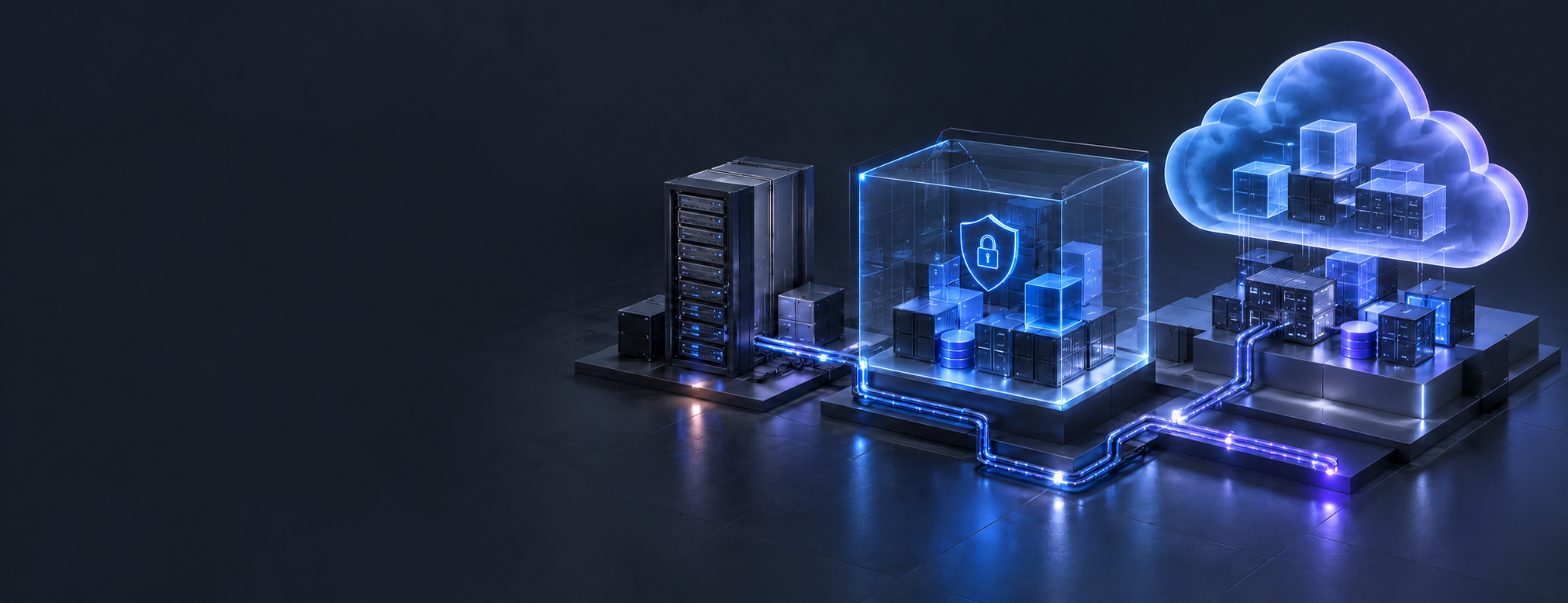
Cloud Strategy Development
Build a Cloud Strategy Around Your Business Goals
Senseti helps businesses determine which systems should move to the cloud, which should remain on-premises, and how to choose the right infrastructure model.
We analyze applications, workloads, costs, and business requirements. We compare Azure, AWS, Google Cloud, and hybrid approaches, design your target architecture, and develop a roadmap with clear priorities and budget considerations.



15+
years of IT experience
50+
technology partners
98%
client satisfaction
Your Cloud Should Solve Business Problems, Not Create New Ones
Moving to the cloud does not always mean lower costs or simpler infrastructure. Without a clear strategy, your business may end up with a complex architecture, unpredictable expenses, and new dependencies between systems.
Not every application needs to move. Sometimes modernizing an existing solution, choosing a hybrid model, or keeping a system on-premises makes better business sense.
Senseti helps you compare options before making major investments and develop a technically and financially sound cloud transformation plan.
Where Cloud Initiatives Lose Their Value
Cloud technologies create new opportunities, but without a strategy, they can also increase costs and complicate IT management. Poor decisions about platforms, application placement, and migration planning can affect business operations for years.
Unclear Cloud Adoption Goals
Cloud services are introduced without defined business objectives or success criteria. Investment increases, but the company cannot objectively measure the results of its transformation.
Choosing the Wrong Cloud Model
Public, private, hybrid, or multicloud architectures are selected without a thorough assessment of systems, data, and requirements. This can lead to unnecessary expenses and operational limitations.
Inefficient Application Placement
Not every system should move to the cloud without modification. Choosing the wrong environment can reduce performance, increase latency, and complicate integrations.
Unpredictable Cloud Costs
Without a financial model, spending on computing, storage, network traffic, and licenses may exceed the planned budget. Additional expenses often become apparent only after migration.
Overlooked System Dependencies
Applications depend on databases, networks, authentication systems, and other services. Migrating without understanding these connections can disrupt critical business processes.
Security Considered Too Late
Requirements for data protection, access, backup, and regulatory compliance are defined after architectural decisions have already been made. Correcting these issues may require additional investment.
No Clear Transformation Roadmap
Cloud projects are launched without shared priorities or an agreed sequence of activities. Teams work on separate initiatives without considering dependencies or infrastructure readiness.
Limited Organizational Readiness
A company may lack the cloud management processes, internal expertise, or cost control tools needed for successful adoption. Even the right platform may fail to deliver the expected value without operational readiness.
Comprehensive Cloud Strategy Development
Senseti evaluates your business requirements, existing IT environment, financial considerations, and risks. Based on this analysis, we develop recommendations for cloud architecture and the sequence of changes across your systems.

Current IT Infrastructure Assessment
We examine servers, applications, data, networks, and connections between systems. We identify technical limitations, critical dependencies, and the characteristics of your existing architecture.
Cloud Readiness Assessment
We evaluate whether your technology, IT processes, and team are ready to adopt cloud services. We identify the changes required before migration or modernization begins.

Application and Workload Analysis
We assess systems based on criticality, performance, data requirements, and integrations. We determine suitable approaches: retain on-premises, migrate, modernize, or replace.
Cloud Model Selection
We compare public, private, hybrid, and multicloud architectures. We consider requirements for scalability, availability, security, management, and cost.
Platform and Workload Placement
We evaluate Microsoft Azure, AWS, Google Cloud, private clouds, and on-premises infrastructure. We recommend where to host systems based on technical requirements, constraints, and financial viability.

Financial Modeling and TCO
We estimate costs for resources, licenses, data transfer, migration, and ongoing support. We compare total cost of ownership (TCO) and required investment across different scenarios.

Security and Governance Architecture
We consider requirements for access control, data protection, network architecture, backup, and recovery. We define core principles for cloud governance and applicable compliance requirements.
Cloud Transformation Roadmap
We establish the sequence of changes, priorities, dependencies, and key implementation stages. We define required resources, milestones, and criteria for moving to the next phase.
From Your Current Infrastructure to the Right Cloud Model
For each application and workload, we select an appropriate approach based on business value, technical requirements, risks, and costs. A cloud strategy does not mean that every system must move to the cloud.
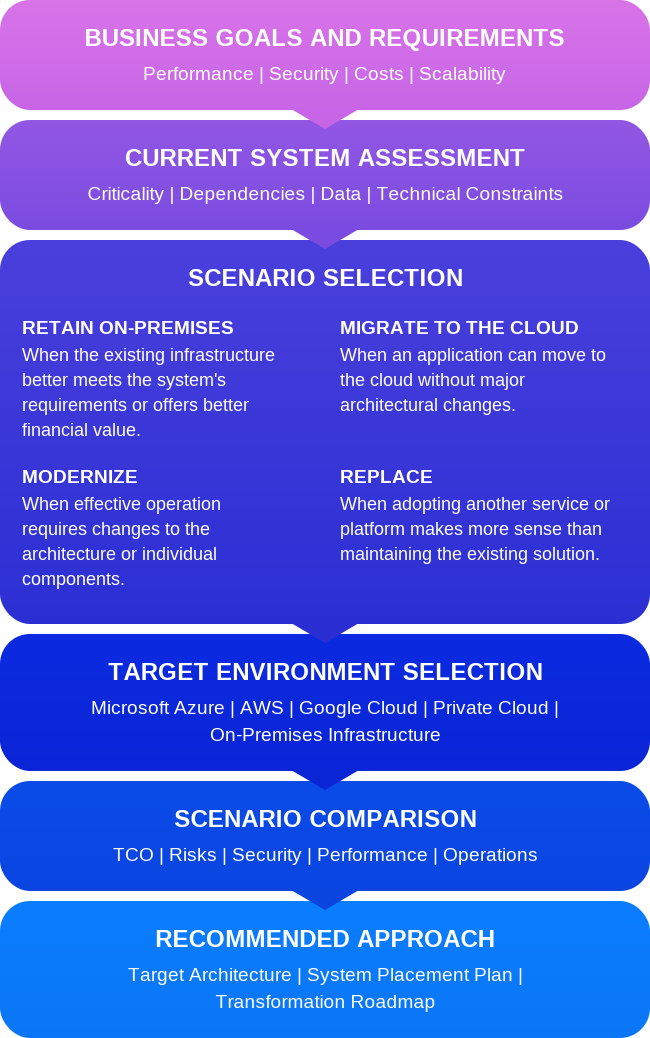
Senseti helps you assess alternatives and determine the most suitable approach for each system. The result is an agreed direction for developing your IT infrastructure, grounded in business priorities and financial analysis.
Platforms and Tools for Cloud Strategy Development
We compare technologies based on application requirements, compatibility, security, and total cost of ownership. Platform selection is driven by your business needs, not by the assumption that every system should move to a single provider.
Microsoft Azure
We assess Azure for enterprise applications, virtual machines, databases, hybrid scenarios, and integration with the Microsoft ecosystem.
Amazon Web Services (AWS)
We evaluate AWS compute, networking, container, and managed services based on architectural requirements and projected costs.
Google Cloud
We analyze Google Cloud capabilities for application hosting, data processing, container environments, and scalable services.
Private Clouds and Virtualization
We assess VMware and other virtualization platforms, private clouds, and on-premises data centers for systems that require specific management or hosting models.
Hybrid and Multicloud Architecture
We evaluate how on-premises systems and multiple cloud platforms can work together, including networking, identities, management, and monitoring.
Financial Modeling and FinOps
We use available cloud provider pricing calculators, existing consumption data, and TCO models to compare costs and evaluate the financial viability of different scenarios.
How We Develop Your Cloud Strategy
Our process includes five consecutive stages. We work with business stakeholders and your IT team to define goals, assess constraints, compare options, and agree on final recommendations.

Business and IT Environment Assessment
We meet with key stakeholders, define business objectives, and agree on which systems to assess. We review available documentation and initial data.
Outcome: An agreed scope of work, system inventory, and initial requirements.

Risk and Constraint Assessment
We analyze application dependencies and requirements for security, availability, and business continuity. We identify technical constraints and areas requiring further investigation.
Outcome: A documented set of agreed requirements, constraints, and key risks.

Scenario Evaluation
We present options for application placement, migration, and modernization. We explain the benefits, limitations, and infrastructure impact of each scenario.
Outcome: Prioritized scenarios for technical and financial evaluation.

Target Model Development
We compare options based on costs, risks, security, and operational requirements. We refine the architecture and agree on recommended solutions.
Outcome: An agreed target cloud model and justification for the selected scenarios.

Strategy and Roadmap Delivery
We prepare final recommendations, a system placement plan, and the proposed implementation sequence. We present the results, priorities, and conditions for proceeding to the next stages.
Outcome: A complete package of strategic deliverables and an agreed cloud transformation roadmap.
A Practical Cloud Transformation Plan, Not Guesswork
Target Architecture
Receive a conceptual design of your future IT environment, including the recommended cloud model, key components, and integration principles.
System Placement Plan
Get recommended approaches for applications and workloads: retain on-premises, migrate, modernize, or replace.
Financial Justification
Receive a comparison of projected costs, TCO, required investments, and key assumptions to support budget planning.
Implementation Roadmap
A step-by-step plan outlining priorities, system dependencies, the sequence of changes, and estimated resources.
A Foundation for Business Decisions
Agreed recommendations help you justify the proposed model to management, develop a budget, and plan specific implementation projects.
When Your Business Needs a Cloud Strategy
First-Time Cloud Adoption
Your company plans to use cloud services but has not yet decided which systems to migrate, which platform to choose, or where to begin.
Data Center Migration
You need to migrate applications, data, and workloads while accounting for technical dependencies, system criticality, and business continuity requirements.
Building Hybrid Infrastructure
Some systems will remain on-premises while others move to the cloud. You need to define how these environments will interact and how access and management will work.
Building a Multicloud Environment
Your company is evaluating multiple cloud providers. You need to make informed decisions about distributing systems across Azure, AWS, Google Cloud, and other platforms.
Modernizing an Existing Cloud Environment
Your cloud infrastructure is already running, but its architecture, performance, or management processes no longer meet business requirements.
Business Expansion
Your current infrastructure cannot keep up with growing workloads, user numbers, or expansion into new markets. You need a sustainable model for future development.
Cloud Cost Optimization
Cloud spending is increasing without corresponding improvements in efficiency. You need to review resource utilization and the financial performance of your infrastructure.
New Security and Compliance Requirements
Your company must address data protection, data residency, access controls, and applicable regulatory obligations, including GDPR, DORA, NIS2, or KSZI.
Turn Your Cloud Plans into a Clear Strategy
Determine which systems should move to the cloud, which architecture to choose, and how to plan your investment. Senseti will develop recommendations and a roadmap based on your business goals, costs, and risks.
Contact Us
A Cloud Strategy That Looks Beyond Technology
Senseti draws on 15+ years of IT experience, collaboration with 50+ technology partners, and hands-on enterprise infrastructure expertise. We help businesses make cloud decisions grounded in technical and financial analysis.

Objective Platform Selection
We compare Azure, AWS, Google Cloud, and hybrid models based on costs, security, and your existing infrastructure.

Financial Clarity for Every Decision
We evaluate TCO, licensing, migration costs, and ongoing support so your cloud investments are backed by clear financial reasoning.

98% Client Satisfaction
We account for business priorities, real-world constraints, and IT team requirements to develop recommendations you can turn into an actionable plan.

From Strategy to Implementation
We design your target architecture and roadmap, and can also manage migration, optimization, and ongoing support when needed.
FAQ
You will receive a target architecture, recommendations for system placement, a scenario comparison with cost projections, and an implementation roadmap. These deliverables can support budget approval and project planning.
The timeline depends on the number of systems, infrastructure complexity, documentation availability, and the depth of analysis required. After an initial discussion, we define the scope and agree on a delivery schedule.
Pricing depends on the size of your IT environment, the number of applications, system dependencies, and the required deliverables. Once we understand your needs, we prepare a proposal with a defined scope, timeline, and budget.
Yes. Input from business and IT stakeholders helps us understand your systems, constraints, and objectives. Senseti conducts the main assessment, while your team participates in interviews and key decisions.
Usually not. We assess your environment through documentation, interviews, and agreed infrastructure data. If additional technical assessment is required, we discuss how to carry it out and minimize any impact on running services.
No. Cloud infrastructure is not always cheaper than on-premises systems. A strategy helps compare options based on projected total cost of ownership (TCO) and identify the most financially suitable model.
Contact Us
Send a message to our team to find out how we can help you