

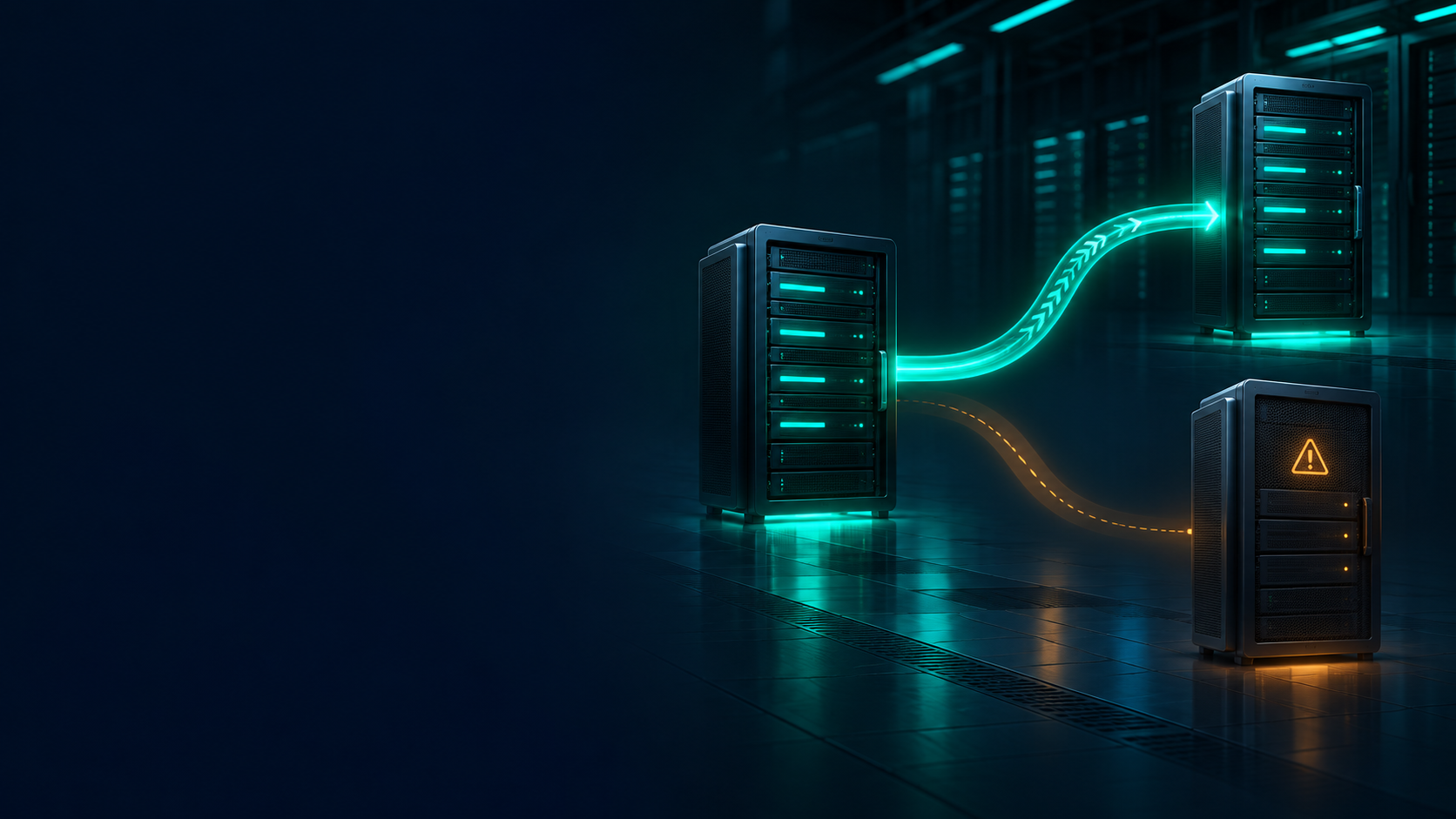
High Availability Server Deployment (HA)
Keep Critical Services Running When Individual Components Fail
Senseti designs and deploys high availability infrastructure for physical servers, virtual machines, databases, and hybrid environments.
We identify single points of failure (SPOFs), implement clustering, redundancy, and automatic failover. We agree on target RTO/RPO values, simulate failure scenarios, and document the results.








15+
years of IT experience
50+
technology partners
98%
client satisfaction
High Availability Takes More Than a Second Server
Every business-critical service depends on a chain of components: compute nodes, networks, storage, power, virtualization, and applications. The failure of a single non-redundant component can bring the entire service down.
Even two functioning servers cannot guarantee high availability if they rely on a single storage system, network device, or incorrectly configured failover mechanism.
Senseti designs HA architectures around your business requirements. We establish acceptable downtime and data loss thresholds, address critical dependencies, and verify how your infrastructure behaves under defined failure scenarios.
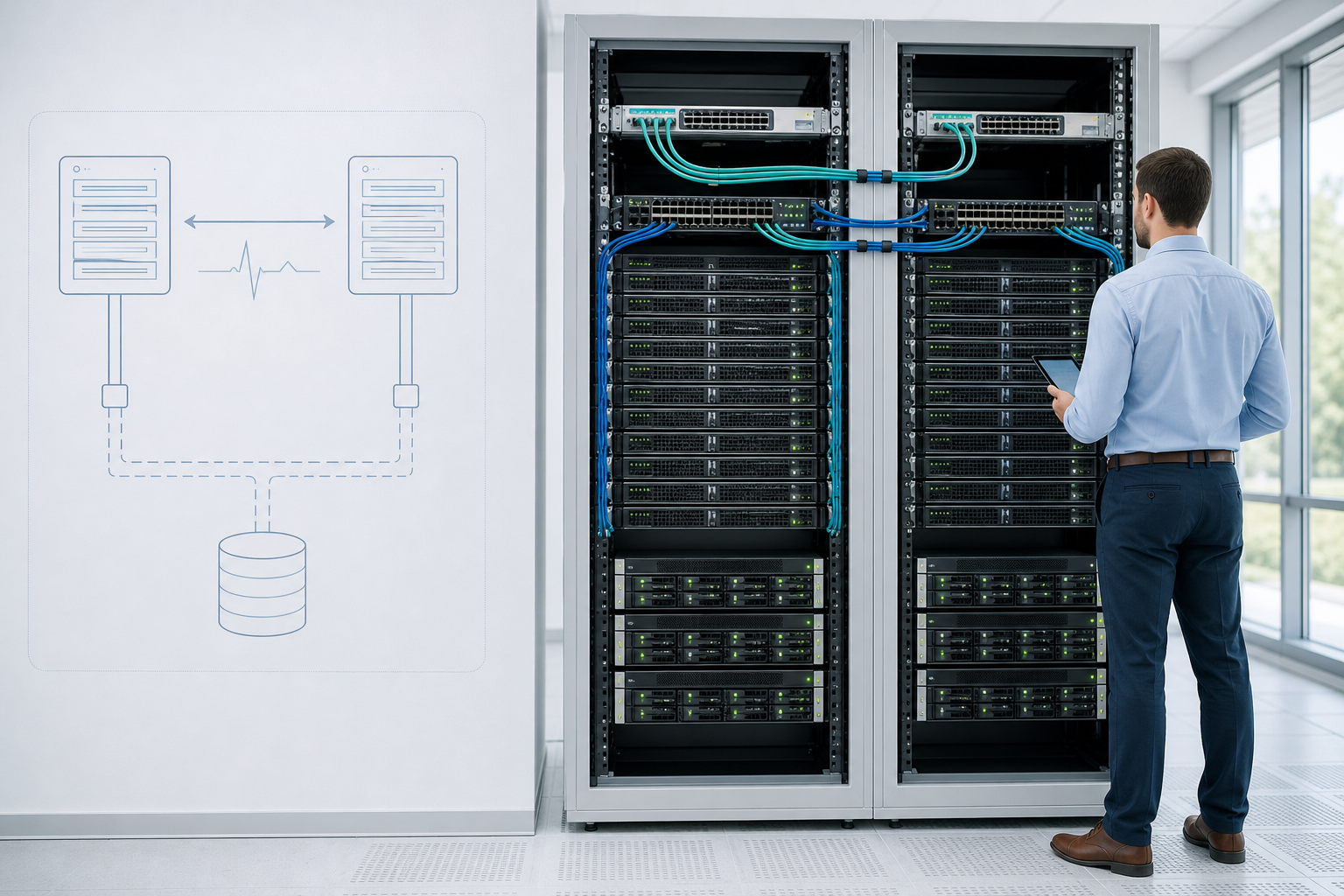
Where Infrastructure Resilience Breaks Down
Redundant servers alone do not guarantee service availability. If networks, storage, or failover mechanisms remain vulnerable, one component failure can interrupt critical business operations.
Single Points of Failure
A single server, switch, storage controller, or network connection can make an entire system unavailable. Without dependency analysis, these risks are not always obvious.
Manual Recovery
Without automatic failover, administrators must manually restart services on a standby node. This increases downtime and makes recovery dependent on IT team intervention.
Non-Redundant Storage
Even healthy servers cannot keep applications available if their data resides on a failed storage system. Problems with controllers, disk arrays, or storage access paths can bring down the cluster.
Lack of Network Redundancy
A single switch, network interface, or route creates a critical dependency. Users may lose access to services even while the server nodes remain operational.
Untested Failover
Having a standby node does not mean failover will work correctly. Configuration errors, unresolved dependencies, or automation failures may only become apparent during a real incident.
Split-Brain and Data Corruption
When communication between nodes is lost, multiple nodes may believe they are active. Without proper quorum and node fencing, conflicting writes can compromise data integrity.
Insufficient Spare Capacity
A standby node may lack the resources to handle the full workload. If capacity is planned only for normal operation, critical service performance may deteriorate significantly after a failure.
Undefined RTO/RPO Targets
Without agreed recovery objectives, selecting the right architecture and validating its effectiveness becomes difficult. Business expectations may not match the infrastructure's actual capabilities.
Comprehensive High Availability Infrastructure
Senseti designs HA as an interconnected system. We combine server redundancy with resilient networking, storage, virtualization, application-level protection, and validated failover mechanisms.
HA Clusters
We design and deploy high availability clusters for physical servers, virtual machines, databases, and mission-critical applications. We define the required nodes, their dependencies, and the conditions for automatic service recovery.
Active-Active and Active-Passive Architectures
We select the workload distribution model based on application capabilities, performance, availability requirements, and budget. We configure active and standby nodes according to the chosen architecture.
Automatic Failover
We configure failure detection and automatic failover of cluster resources to available nodes. We validate service startup sequences, connection recovery, and alignment with agreed availability requirements.
Quorum and Split-Brain Prevention
We configure quorum, witness mechanisms, and supported fencing capabilities, including STONITH where applicable. These controls help prevent conflicting resource ownership and simultaneous data writes from nodes that have lost cluster coordination.
Resilient Data Storage
We design shared or replicated storage architectures with redundant controllers and access paths. We use synchronous or asynchronous replication based on data integrity requirements and target RPO values.
Network Redundancy
We design redundant network interfaces, switches, and routes. We configure supported client connection failover mechanisms, virtual IP addresses, and load balancing.
Virtualization and Database High Availability
We configure hypervisor HA mechanisms, database clustering, and supported workload recovery scenarios. We account for the differences between restarting a virtual machine, failing over an application, and restoring database connections.
Monitoring and Resilience Testing
We monitor node health, cluster resources, quorum, replication, and network connectivity. We simulate agreed failure scenarios, measure actual RTO/RPO performance, and document test results.
HA Architecture: From Failure Detection to Service Recovery
High availability depends on the coordinated operation of server nodes, networks, storage, and cluster management. When a component fails, the system must detect the failure, maintain control over its resources, and execute the configured failover procedure.
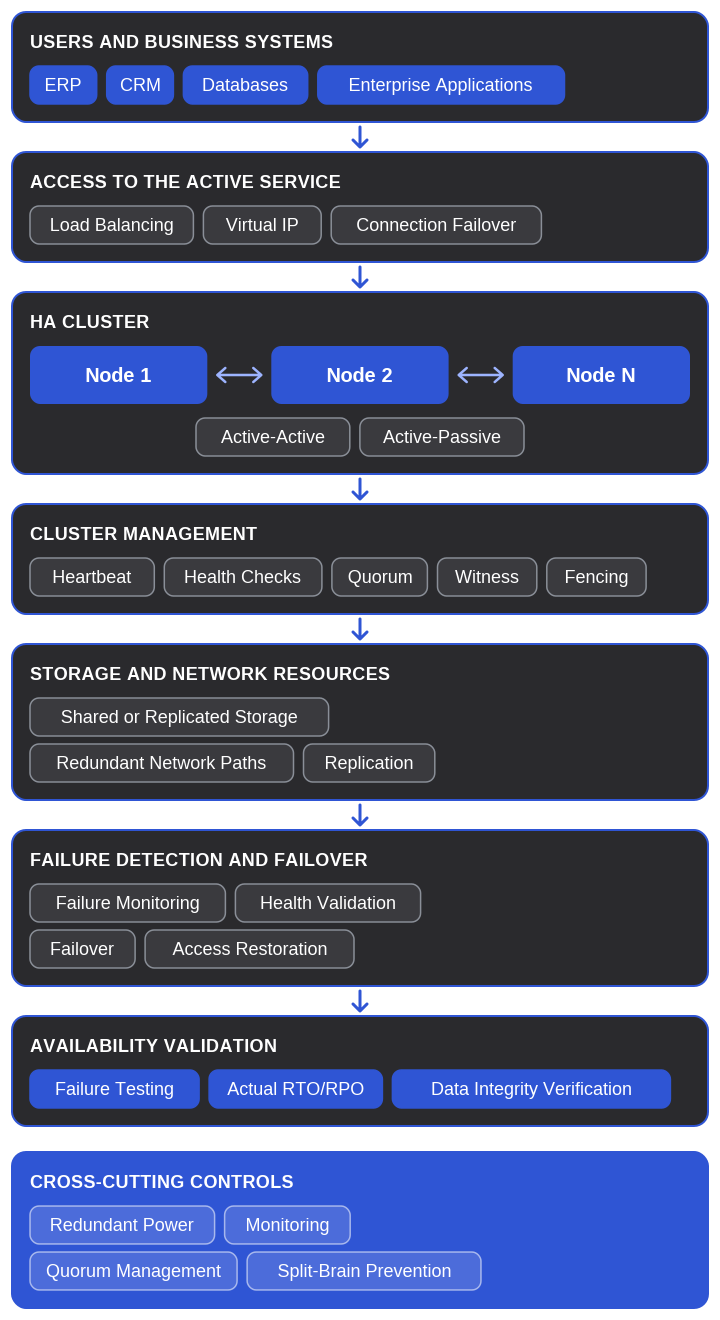
Senseti designs the interaction between these layers to help ensure that failover does not introduce additional risks to data or dependent services. We validate actual system behavior through testing.
Technologies for Resilient Infrastructure
We select platforms based on your existing servers, virtualization environment, databases, RTO/RPO requirements, and application capabilities. We verify compatibility, licensing, and limitations of supported failover scenarios.
Microsoft Infrastructure
Windows Server Failover Clustering, Hyper-V, and SQL Server Always On for server, virtual machine, and database clustering. We select suitable failover mechanisms based on the architecture and product editions in use.
VMware
VMware vSphere HA for automatically restarting virtual machines after a host failure. We evaluate VMware Fault Tolerance for supported workloads requiring a different level of execution continuity.
Linux HA and Clustering
Pacemaker and Corosync for cluster management, and DRBD/LINSTOR for data replication. For PostgreSQL, we evaluate Patroni and supported mechanisms for leader election and automatic failover.
HCI and Alternative Virtualization
Nutanix, KVM, and Proxmox VE for server clustering and virtualization. We evaluate Ceph and other distributed storage systems based on redundancy, data availability, and performance requirements.
Enterprise Servers and Storage Systems
Dell Technologies, HPE, and other enterprise solutions for servers, storage systems, and redundant connections. We select configurations based on availability requirements, component compatibility, and expected workloads.



How We Deploy HA Infrastructure
We begin by assessing critical services and identifying single points of failure. Then we design the architecture, deploy the cluster, and validate its behavior under agreed failure scenarios.

Infrastructure and Requirements Assessment
We identify critical services, system dependencies, and existing redundancy mechanisms. We assess servers, networks, storage, virtualization, and power infrastructure. We define acceptable downtime and data loss.
Outcome: An inventory of SPOFs, a dependency map, and agreed target RTO/RPO values.

HA Architecture Design
We select an Active-Active or Active-Passive model, define cluster nodes, storage architecture, network redundancy, and failover mechanisms. We design quorum, witness, fencing, and monitoring controls.
Outcome: An HA architecture design, technical specifications, and an implementation plan.

Deployment and Configuration
We configure cluster nodes, replication, load balancing, and automatic failover mechanisms. We integrate the solution with your existing infrastructure and monitoring systems.
Outcome: A deployed HA cluster with configured resilience mechanisms.

Failure Scenario Testing
We simulate agreed node, network, and storage component failures. We verify failover, client connection recovery, data integrity, and actual recovery performance.
Outcome: A test report with measured RTO/RPO values and documented limitations.

Operational Handover and Support
We document the architecture, configurations, maintenance procedures, and recovery scenarios. We hand the system over to your IT team and can arrange ongoing monitoring and technical support when required.
Outcome: A validated HA environment, operational documentation, and an agreed support process.
Predictable Recovery Instead of Hoping the Standby Server Works
Controlled Recovery Time
We design failover around agreed RTO targets. During testing, we measure actual service recovery time and document the results.
Reduced Risk of Data Loss
We select replication mechanisms based on your acceptable RPO. For systems requiring RPO = 0, we verify whether that objective is achievable under defined failure scenarios.
Maintenance with Less Business Disruption
Where supported, we design the infrastructure to allow updates and replacement of redundant components without stopping services. Required maintenance windows and limitations are agreed in advance.
Validated Failure Readiness
We test failure and failover scenarios rather than simply checking whether standby nodes exist. We document infrastructure behavior and identified limitations.
Greater Resilience for Critical Services
We select HA mechanisms for ERP, CRM, databases, and enterprise applications based on their dependencies and data integrity requirements.
Scalability with Spare Capacity
We design cluster expansion with additional nodes and resources in mind. We verify whether the infrastructure can sustain the required workload after a component failure.
Which Systems Need High Availability?
High availability is particularly important for services where downtime affects employees, customers, and essential business operations. The right mechanisms depend on the architecture and capabilities of each application.
Databases
Microsoft SQL Server, PostgreSQL, and other database platforms that require replication, active-node failover, and data integrity controls.
ERP and CRM Systems
Financial, manufacturing, and customer management systems where downtime interrupts business operations. These require coordinated redundancy across applications, databases, and infrastructure components.
Virtual Infrastructure
VMware, Hyper-V, and HCI environments that require automated virtual machine restart or failover after a host failure.
File and Enterprise Services
File shares, directory services, and other internal systems that depend on reliable data access and redundant critical components.
Business Applications
Internal portals, web services, and customer-facing applications that use load balancing, clustering, and failover between available instances.
Critical Infrastructure Services
Systems and services that other parts of the corporate IT environment depend on. These require redundancy for nodes, network connections, and essential resources.
Can Your Critical Services Survive a Single Server Failure?
We will assess your infrastructure, identify single points of failure, and determine where clustering, redundancy, and automatic failover are needed. Senseti will help design an HA architecture around agreed availability requirements and develop a plan to validate its performance during failures.
Contact UsResilience Proven Through Testing
Senseti combines 15+ years of IT infrastructure experience with access to solutions from 50+ technology partners. We design high availability around servers, networks, storage, virtualization, and critical application dependencies.

We Assess the Entire Service Chain
We identify single points of failure not only in servers, but also in networking, data storage, power infrastructure, and failover mechanisms.

Architecture Built Around Your Requirements
We compare Active-Active and Active-Passive models and select appropriate platforms and redundancy mechanisms based on RTO/RPO targets and budget.

98% Client Satisfaction
We agree on failure scenarios, conduct tests, and document results so your IT team understands the system's actual capabilities and limitations.

From Design to Ongoing Support
We deploy HA clusters, validate failover, and provide documentation. When needed, we arrange monitoring, maintenance, and further infrastructure development.
FAQ
An HA cluster connects two or more nodes to support the availability of critical services. If a node fails, the cluster can automatically fail over or restart the workload on another node, reducing downtime.
HA is designed to reduce downtime caused by component failures. Backup allows data to be restored from a saved copy, while DR provides a process for restoring systems after a major disaster. These mechanisms complement one another.
Depending on the architecture, redundancy may be required for servers, network interfaces, switches, storage systems, controllers, communication links, and power supplies. Availability at the hypervisor, database, and application levels must also be considered.
In an Active-Active architecture, multiple nodes can serve workloads simultaneously. In Active-Passive, a standby node takes over the active role after the primary node fails. The right model depends on application capabilities and data requirements.
The cluster detects the failure and executes the configured failover procedure. Depending on the platform, the service may move, restart, or continue running on other nodes. Brief connection interruptions may still occur.
In many cases, yes. We first evaluate hardware compatibility, compute resources, networking, storage, and software platforms. We then determine which components can be reused and which require upgrades.
Contact Us
Send a message to our team to find out how we can help you