


LAN / WAN Networks
Enterprise Networks That Connect Your People, Services, and Locations
Senseti designs, deploys, and modernizes enterprise LAN / WAN networks for offices, businesses, branch locations, data centers, and distributed IT environments.
We bring local networks and inter-site connectivity together into a unified architecture. We configure switching, routing, segmentation, redundancy, and traffic management around performance, security, and future business growth.








15+
years of IT experience
50+
technology partners
200+
IT systems designed
Reliable Connectivity Starts with the Right Architecture
Every working day, your corporate network handles thousands of requests. Employees access applications, branch offices exchange data, IP telephony carries voice traffic, and servers communicate with cloud services.
When everything works, the network is almost invisible. But an overloaded link, a failed switch, or a routing error can disrupt operations across multiple departments at once.
Senseti helps build networks where local performance, connectivity between locations, and infrastructure management work together. We design architectures based on actual workloads, technical requirements, and your company's growth plans.
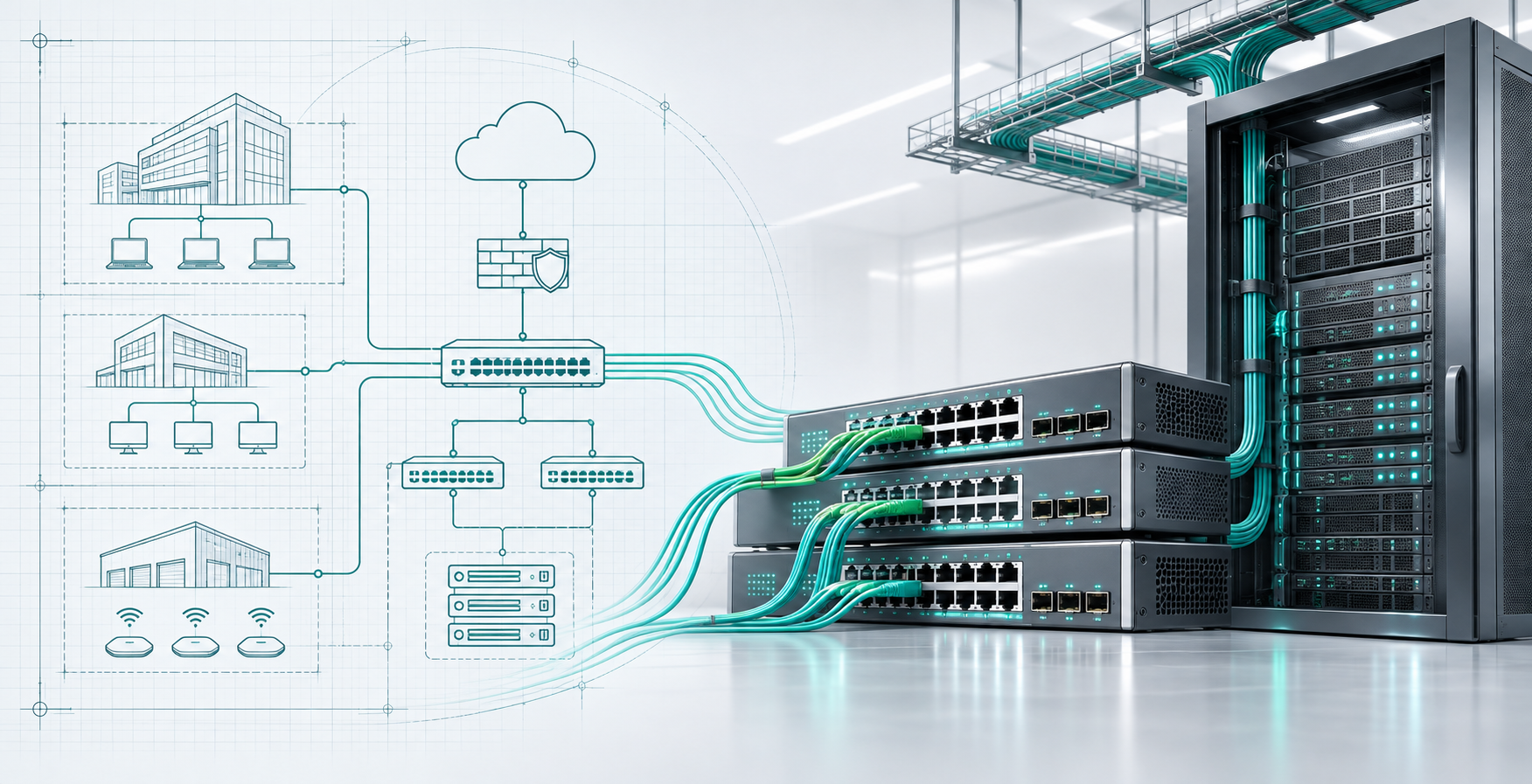
Where Enterprise Networks Start Holding Business Back
LAN / WAN problems do not always begin with a complete outage. Latency increases, individual segments become overloaded, and routing grows more complex. Eventually, launching a new service or connecting another branch becomes a major infrastructure project.
Overloaded Network Segments
The number of users, devices, and applications increases while network bandwidth and equipment capacity remain unchanged. During peak periods, latency, packet loss, and connection issues begin affecting business applications.
Single Points of Failure
A single core switch, router, gateway, or uplink may provide connectivity for an entire department. If that component fails, users can lose access to essential corporate systems.
Insufficient Network Segmentation
Workstations, servers, IP telephony, IoT, and guest devices operate in an inadequately segmented network. This makes access control, traffic management, and troubleshooting more difficult.
Outdated Network Architecture
New switches, VLANs, routes, and sites are added to the same topology over many years. The network becomes harder to maintain, and individual changes may affect unexpected dependencies.
Unstable Connectivity Between Locations
High latency, packet loss, and WAN link failures can affect ERP, CRM, IP telephony, video conferencing, and access to corporate applications across different sites.
No Redundant Network Paths
When a branch or data center relies on a single connection, a provider outage or network device failure can completely interrupt access to essential business services.
Insufficient Traffic Prioritization
Critical applications compete for bandwidth with file transfers, backups, and lower-priority traffic. Without QoS policies, latency-sensitive services may experience inconsistent performance.
Limited Network Visibility
Actual topology, configurations, and routing may no longer match the documentation. Without monitoring and up-to-date network diagrams, troubleshooting takes longer and depends heavily on individual administrators.
Comprehensive Enterprise LAN / WAN Solutions
Senseti designs and implements network solutions as a coordinated system. We can build a new infrastructure, modernize an existing network, or deploy individual components without replacing equipment unnecessarily.
LAN Design
We design local network topologies for offices, businesses, buildings, and campuses. We define access, distribution, and core layers, required bandwidth, redundancy, segmentation, and equipment specifications.
L2/L3 Switching
We deploy and modernize access, distribution, and core switches. We configure VLANs, PoE, uplinks, switch stacking, and supported redundancy mechanisms according to the network topology and workload requirements.
Enterprise Routing
We design routing between VLANs, network segments, branch offices, and data centers. We implement static routing, OSPF, BGP, and other mechanisms based on network scale and resilience requirements.
Network Segmentation
We separate workstations, servers, guest devices, IoT, IP telephony, and business-critical services. We use VLANs, VRFs, ACLs, and other segmentation mechanisms to control connectivity and communication between network segments.
LAN / WAN Resilience
We design redundancy for switches, gateways, uplinks, and WAN connections. We configure supported failover mechanisms and validate network behavior under defined failure scenarios.
Enterprise WAN Connectivity
We connect offices, branches, data centers, cloud resources, and remote sites. We select WAN topologies, connectivity technologies, routing methods, and redundant links based on service criticality.
QoS and Traffic Management
We classify traffic and prioritize IP telephony, video conferencing, ERP, CRM, and other applications. We configure QoS policies based on available bandwidth, latency sensitivity, and service requirements.
Network Modernization and Integration
We upgrade outdated components, redesign network topologies, and integrate equipment from different vendors. We develop phased migration plans that preserve compatible infrastructure and reduce disruption to business operations.
One Network Architecture, from Workstations to the Cloud
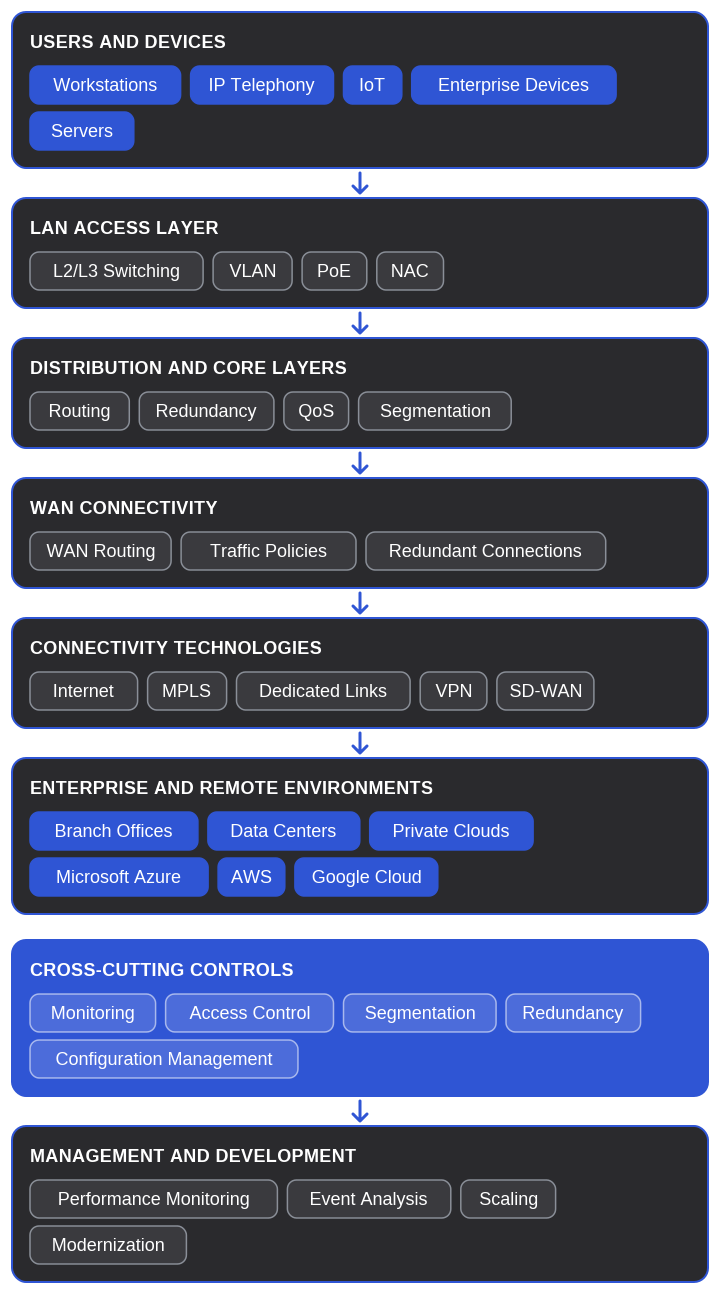
LAN connects users, devices, and servers within a location. WAN connects offices, branches, data centers, and cloud environments. Senseti designs both layers with consistent routing, segmentation, and redundancy principles.
LAN: Reliable Connectivity Within Each Location
We design two-tier or three-tier architectures based on network scale and the number of connected devices. We determine bandwidth requirements, switching layers, segmentation policies, and redundancy mechanisms.
WAN: Reliable Connectivity Between Locations
We connect geographically distributed networks using suitable communication links and routing technologies. We account for redundant paths, application requirements, and future branch expansion.
Senseti integrates LAN and WAN into a unified, manageable architecture so local networks, enterprise applications, and remote locations operate together.
Technologies for Enterprise LAN / WAN Networks
Senseti selects network platforms based on infrastructure scale, workloads, security requirements, and budget. We work with equipment from multiple vendors and evaluate how new solutions can integrate with your existing network.
Cisco
Solutions for enterprise switching, routing, and network core infrastructure. We use Cisco for campus networks, distributed environments, and centralized management of network resources.
HPE Aruba Networking
Platforms for enterprise LAN, switching, and wireless connectivity. We use HPE Aruba Networking for access and distribution layers, enterprise Wi-Fi, and centralized network management.
Juniper Networks and Extreme Networks
Solutions for high-performance switching, routing, and network core infrastructure. We use these platforms in data centers, enterprise campuses, and demanding distributed environments.
Fortinet
Solutions for secure routing, segmentation, and network traffic management. We use Fortinet for branch connectivity, Secure SD-WAN deployments, and integration of networking with security controls.
MikroTik and Ubiquiti UniFi
Platforms for routing, switching, and enterprise wireless networks. We use them in offices and branches where functionality, centralized management, and cost efficiency are important.
Multi-Vendor Networks
We integrate network equipment from different manufacturers into a coordinated infrastructure. We verify protocol, feature, and configuration compatibility to support interoperability between existing and new solutions.







How We Build and Modernize LAN / WAN Networks
We start by understanding your existing network, actual workloads, and business requirements. We then develop the target architecture, plan changes, deploy equipment, and validate the results before operational handover.

Network Infrastructure Audit
We assess the actual topology, switches, routers, communication links, VLANs, IP addressing, and routing protocols. We analyze interface utilization, network dependencies, single points of failure, and scalability limitations.
Outcome: An up-to-date assessment of the network, identified issues, and modernization priorities.

Network Architecture Design
We define the target LAN / WAN topology, switching layers, bandwidth, routing, VLANs, segmentation, QoS, and redundancy. We select suitable network platforms and prepare technical specifications.
Outcome: A target network architecture design and a list of required solutions.

Migration Planning
We develop the transition sequence from the existing network to the new architecture. We agree on maintenance windows, segment cutovers, critical dependencies, and rollback procedures.
Outcome: An approved migration plan with measures to reduce disruption to users and business services.

Deployment and Configuration
We install and configure switches, routers, and other network components. We implement routing, VLANs, QoS, redundant connections, and the required WAN integrations.
Outcome: A deployed and configured LAN / WAN infrastructure ready for validation.

Testing and Operational Handover
We validate connectivity, routing, bandwidth, segment availability, and redundant paths. We test planned failover scenarios, update diagrams and configurations, and hand over documentation to your IT team.
Outcome: A validated network, documented test results, and technical documentation for ongoing operations.
A Network with Performance and Growth You Can Manage
Predictable Application Performance
We design bandwidth, routing, and QoS around actual workloads. We account for latency, packet loss, and the performance requirements of business-critical services.
Lower Risk of Network Downtime
We provide redundancy for critical components, links, and routes. We validate failover under defined failure scenarios and assess actual recovery times.
Scalability Without Replacing the Entire Network
We plan network expansion to support additional users, devices, and locations. We retain equipment that meets the requirements of the target architecture.
Easier Infrastructure Management
Up-to-date documentation, monitoring, and a coordinated architecture help IT teams identify problems faster and reduce repetitive manual tasks.
Better-Informed Network Investments
Technical audits and architecture design help determine which components genuinely require modernization and which can remain in service.
When Your Business Needs LAN / WAN Deployment or Modernization
Opening a New Office or Facility
You need a local network for employees, servers, IP telephony, IoT, and other equipment. We design the topology, switching, routing, segmentation, and redundancy around expected workloads.
Modernizing an Outdated Network
Existing switches and routers limit performance, are approaching end of support, or make operations unnecessarily complex. We define the target architecture and develop a phased upgrade plan.
Connecting New Branch Offices
New offices need reliable connections to enterprise infrastructure, data centers, and cloud services. We design WAN connectivity, routing, and redundant communication links.
Increasing Network Demand
The number of users, devices, and applications is growing. IP telephony, video conferencing, and cloud services require additional bandwidth, so we assess bottlenecks and plan capacity expansion.
Recurring Network Failures
Intermittent connectivity loss, unstable application performance, and high latency may indicate problems with network topology, routing, or overloaded links. We audit the environment to identify underlying causes.
Moving to a New Network Architecture
Your company plans to change its topology, equipment, IP addressing, or segmentation. We develop a controlled migration process with testing and rollback procedures.
Integrating Equipment from Multiple Vendors
Your network uses platforms from different manufacturers that need to operate together. We verify protocol, feature, redundancy, and management compatibility.
Improving Network Manageability
Documentation is outdated, monitoring is fragmented, and troubleshooting depends on individual specialists. We update network diagrams, implement appropriate monitoring tools, and organize configuration management.
Is Your Network Ready for Business Growth?
We will audit your LAN / WAN, identify bottlenecks, and design a network architecture around performance, redundancy, security, and future scalability. We will determine which equipment can be retained, what needs upgrading, and how to implement changes with minimal disruption to your business.
Contact UsNetwork Architecture Without Vendor Lock-In
Senseti combines 15+ years of IT experience, a track record of designing 200+ IT systems, and access to solutions from 50+ technology partners. We build enterprise networks around actual workloads, existing infrastructure, and future growth requirements.

Architecture Before Equipment
We assess network topology, dependencies, and application requirements before selecting switches, routers, and network platforms.

Multi-Vendor Integration
We connect solutions from different manufacturers and verify interoperability across protocols, features, and management mechanisms.

Protecting Existing Investments
We do not recommend complete network replacement when existing equipment meets requirements. We identify what can be reused and what needs upgrading.

Controlled Migration and Support
We plan migrations, agree on maintenance windows, validate network operation, and provide documentation. Ongoing support can be arranged when required.
Frequently Asked Questions About LAN / WAN Networks
LAN connects users, servers, and devices within an office, building, or other local site. WAN provides connectivity between geographically distributed offices, branches, data centers, and cloud environments.
Common signs include overloaded links, insufficient bandwidth, outdated equipment, recurring failures, complex topology, and difficulties connecting new users or services. A network audit helps identify the causes and priorities for modernization.
In many cases, yes. We organize work in stages with agreed maintenance windows, testing, and rollback procedures. Some cutovers may still require brief service interruptions.
The choice depends on network scale, device count, traffic volume, resilience requirements, and future expansion plans. Some sites only need access and core layers, while others require a separate distribution layer.
We design redundancy for critical switches, gateways, uplinks, and routes. We select supported failover mechanisms and validate them under defined failure scenarios.
Yes, provided it is compatible with the target architecture, supports the necessary features, and meets performance and security requirements. During the audit, we identify what should be retained, upgraded, or replaced.
Contact Us
Send a message to our team to find out how we can help you