Remote and hybrid work have broken the traditional boundaries of security. Why old approaches no longer work, how to protect users, devices and clouds, and which solutions, Zero Trust, XDR, SASE and Cisco Secure, help businesses adapt to the new digital reality.
A New Digital Reality: When the Perimeter No Longer Exists
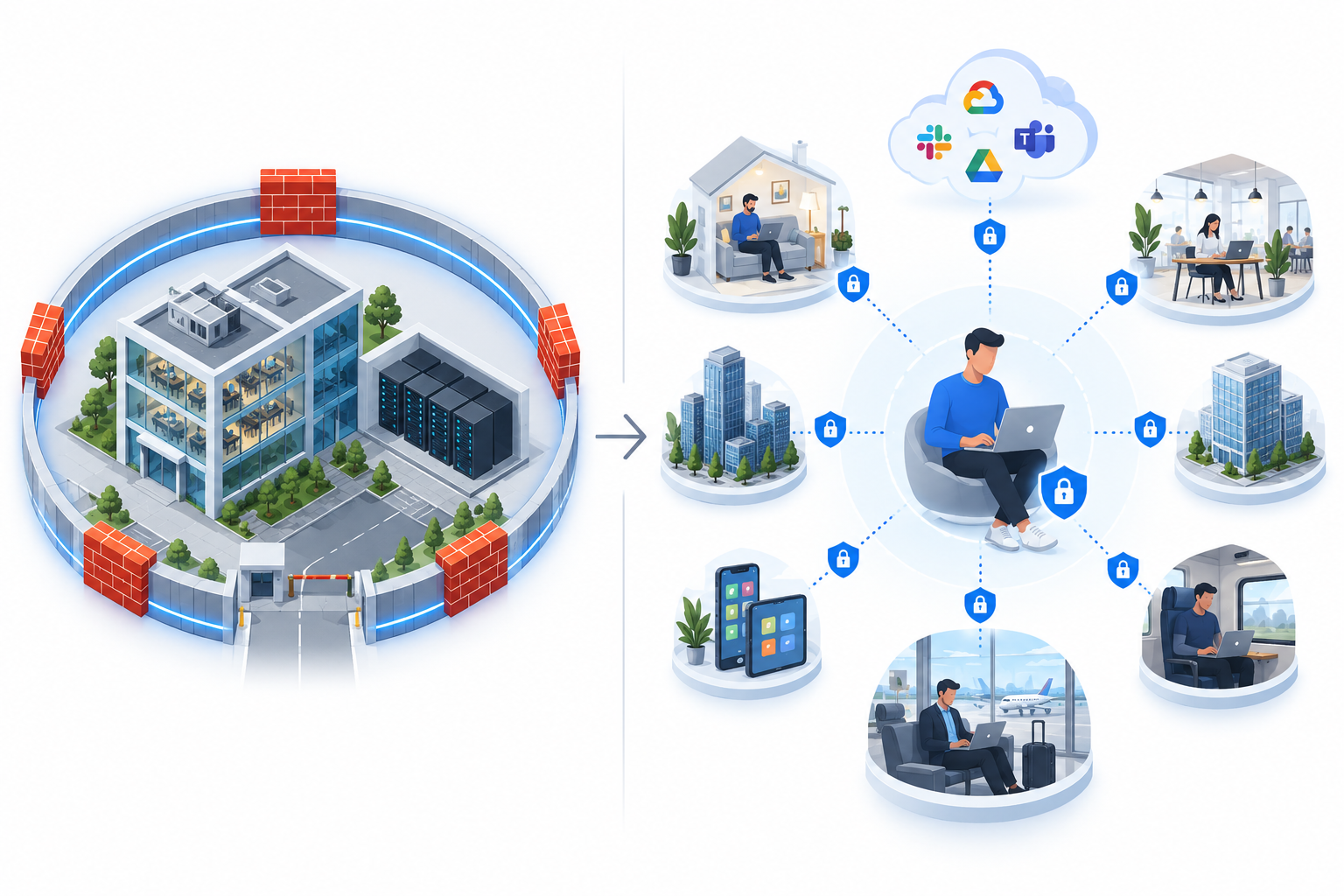
The last few years have become a period of rapid transformation for the entire digital infrastructure. The mass shift to remote or hybrid work has fundamentally changed the traditional understanding of a company’s IT perimeter. Today, it is impossible to clearly define where the corporate network ends, it is dynamic and blurred.
Previously, IT security was built around the physical office, server room or corporate data center. Now, the user has become the core element of the infrastructure: with their device, access channels, applications and work scenarios.
Factors that destroyed the traditional security perimeter:
Remote and hybrid work as the new norm
BYOD (Bring Your Own Device) and the widespread use of personal devices for work
Decentralized access: office, home, coworking space, train, hotel, all of this is now part of modern infrastructure
Growth of cloud solutions and SaaS as the main model for consuming IT services
Without revising protection strategies, this format creates high risks: attacks have shifted from servers to users, from applications to devices and connections. As a result, companies face the need to implement flexible, scalable and carefully designed cybersecurity models that do not just respond to incidents, but prevent them.
How the Threat Model Has Changed and Why Attacks Have Gone Out of Control
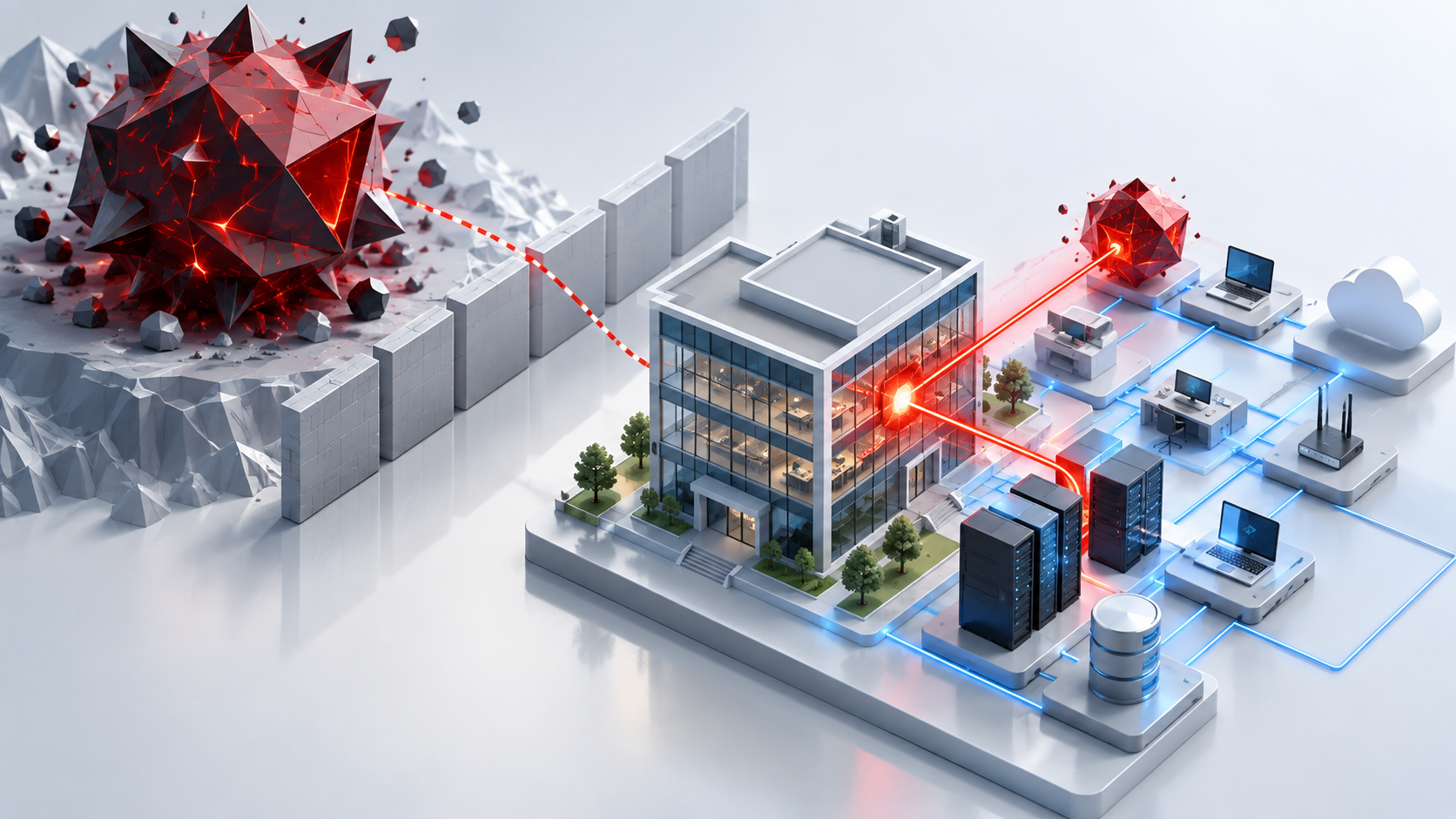
The change in the work model has also caused a radical shift in the threat landscape. Most cyberattacks today are not aimed at infrastructure itself, but at its most vulnerable part, the human. It is the user, their behavior and their environment that have become the “entry point” into corporate systems.
What has increased vulnerability?
Shadow IT: employees independently connect external services without notifying the IT department
Phishing and social engineering: attacks are becoming more sophisticated and personalized
Zero-day vulnerabilities: attackers increasingly gain a time advantage while patches have not yet been released
Unprotected home networks: attacks through vulnerable routers, public Wi-Fi or compromised IoT devices
Every new connection, device or application is a potential attack vector. When a business has hundreds or thousands of distributed employees, controlling all these points becomes impossible within old architectures.
Conclusion: companies can no longer rely on static protection measures. They need to move from reactive tools to Zero Trust and XDR (Extended Detection & Response) strategies, approaches that provide continuous verification, contextual control and proactive response to threats.
Blurred Infrastructure: When the Device and Connection Are Outside Control
In remote and hybrid work conditions, the boundary between work and personal devices has almost disappeared. Employees use corporate laptops not only for work tasks, but also in everyday life. At the same time, some employees prefer to connect to systems from personal devices, bypassing corporate rules.
What does this mean for security architecture?
Devices become “shared”: family members, children and guests may get access to laptops
Personal devices remain outside centralized control: without update policies, antivirus tools or encryption
The level of protection varies greatly: from fully managed endpoints to vulnerable home PCs
All of this creates a strong flow of traffic from unverified sources and makes traditional protection systems powerless.
Relevant technology solutions:
Cisco Secure Endpoint, formerly AMP for Endpoints, a platform combining 15 protection modules: from file behavior monitoring to fileless attack detection
Cisco SecureX, an orchestration platform that combines telemetry from different devices and simplifies response
The integration of these solutions provides endpoint protection across the entire chain: from the first connection to event analysis. Detailed analytics, device isolation and automatic threat response are supported, without the need to install physical agents on every device.
The Boundaries Between Personal and Work Have Disappeared, and Access Points Are Becoming Vulnerable
The workplace is no longer tied to an office desk. Today, an employee can connect to a corporate system from a café, train, airport, beach or hotel room. This is convenient for business, mobility increases productivity and process flexibility. But from a cybersecurity perspective, such scenarios create serious vulnerabilities.
Public Wi-Fi networks are inherently unsafe. They can be compromised by attackers who intercept traffic, inject malicious code or simulate access to “familiar” networks. In these conditions, the company loses control not only over the communication channel, but also over the devices employees use. Without proper verification, risks increase many times over.
The solution is to create a protected perimeter, even in an unsafe environment. Cloud platforms play a key role here, providing continuous connection verification regardless of the entry point. Cisco Umbrella provides DNS-layer protection by filtering suspicious requests before they reach the device. The built-in cloud firewall allows flexible access policy management without depending on physical location.
Additionally, using the Cisco AnyConnect client allows organizations to check whether a device complies with security policies, request multi-factor authentication and provide access only to approved applications and systems. This reduces the attack surface and allows the company to maintain control even beyond the traditional perimeter.
Such a connection architecture is built on trust that is confirmed at every stage: device → connection → user. All of this is possible without compromising convenience and speed of work, which is critical for mobile business.
User Experience = A Security Factor
Convenience is not just a user interface element. It is a strategic component of the security system. When employees face authentication overload, complex password change rules or inconvenient interfaces, they start looking for workarounds: writing passwords on sticky notes, using the same combination for all services, ignoring security system notifications.
The result is reduced effectiveness, even for the most advanced solutions. Without user engagement, any technology becomes ineffective.
A user experience-oriented approach makes security an organic part of the workflow. Cisco Duo implements this through the Single Sign-On concept: an employee logs in once and gets access to all necessary services without constantly entering passwords. At the same time, security is maintained through device trust and multi-factor authentication.
Duo also enables conditional access: different users and devices receive different levels of permissions depending on context, location, time of day, threat profile and other factors. This reduces risks and makes the system flexible.
Additionally, user self-service is an important element of mature infrastructure. The ability to independently restore access, change settings or complete verification reduces the load on support and increases response speed.
When security is built into daily work, it becomes not a barrier, but a tool. That is why the modern approach must consider UX alongside technical requirements. Only then will policy compliance become not an obligation, but natural user behavior.
Email as the Main Attack Vector
Email remains the most vulnerable channel in the entire corporate ecosystem. According to statistics, 94% of successful attacks begin with email. This is not surprising: email connects internal and external communications, is used daily by all employees and often becomes the entry point for phishing, malicious attachments and hidden links.
Today’s cyberattacks look less and less like “spam with a virus.” Attackers act more sophisticatedly: they use Business Email Compromise (BEC) techniques, insert themselves into correspondence, disguise URLs, spoof domains and imitate the behavior of real senders. Simple filtering does not help here.
An effective answer is Cisco Cloud Mailbox Defense. It integrates into the corporate ecosystem without disrupting existing processes, with direct integration supported for Microsoft 365 and Google Workspace.
The system analyzes URL links in real time, blocks access to infected pages, uses cloud threat signatures and behavioral algorithms to detect suspicious attachments and interactions. Integration with other Cisco solutions, SecureX, Umbrella and Secure Endpoint, strengthens the effect: when suspicious activity is detected, information is instantly transferred to other systems for cross-correlation and response.
As a result, email stops being a vulnerable area and becomes part of the overall threat prevention system, rather than its weak link.
Zero Trust and Analytics: Security as an Architecture, Not a Set of Tools
Modern security is no longer a collection of disconnected tools, but a unified model built on clear principles. The key paradigm here is Zero Trust: “Trust no one, verify everyone.”
Unlike outdated perimeter-based strategies, Zero Trust assumes that no connection is considered secure by default, even if it originates from inside the network. Every access request is a hypothesis that must be verified. Every user action is an event requiring contextual evaluation: who the user is, where they are connecting from, which device they are using, at what time, and which data they are trying to access.
Implementing such a model is only possible through the integration of solutions into a unified architecture. Within Cisco’s approach, the core Zero Trust components include:
Secure Endpoint, endpoint protection with behavioral analysis
Duo, identity and device trust verification
Umbrella, DNS and network-layer protection
AnyConnect, secure access and protected connectivity
All these components are combined within Cisco XDR, an extended detection and response platform that provides end-to-end visibility, automation and analytical capabilities across all levels of the infrastructure.
Zero Trust architecture does not require abandoning existing infrastructure completely. It can be adapted gradually, starting with the most critical nodes. But the main shift is a change in mindset: security no longer protects walls, it protects access and behavior. This is what allows companies to remain resilient in conditions of decentralization, remote work and constant cyber threats.
Artificial Intelligence and Behavioral Analytics as an Essential Part of the Modern Security Model
Modern cybersecurity no longer relies solely on threat signatures and manual response. In hybrid architectures, remote work environments and a landscape of constantly emerging attack vectors, organizations need a proactive and adaptive approach. This is where behavioral analytics, machine learning and artificial intelligence become critically important.
Collecting telemetry from all levels of infrastructure, from endpoints to cloud environments, makes it possible to build behavioral models of normal interactions between users and systems. These models create a dynamic context against which deviations and anomalies are detected instantly and automatically.
This approach is implemented, for example, in Cisco Secure Analytics, formerly known as Stealthwatch. The platform collects traffic and network data, identifies suspicious patterns and detects attacks before they are activated, without requiring agents to be installed on every device.
A comprehensive effect is achieved by combining these analytical engines with Cisco Talos global threat intelligence and the Cisco XDR platform. ML algorithms automatically classify incidents by priority, block sessions in the case of high-risk anomalies, notify SOC teams and initiate corrective actions.
Example scenario: an employee connects to the corporate network from a new geolocation and initiates an unusual volume of data exports. The system detects abnormal behavior, checks whether it aligns with the expected context and, if inconsistencies are found, automatically blocks the session before a compromise occurs.
This approach minimizes the impact of human error, increases response speed and provides real-time security.
How Hybrid Security Supports Digital Transformation
IT security has traditionally been perceived as a cost center. However, with the transition to cloud environments, remote teams and digital transformation, cybersecurity has become an integral part of business growth strategy.
Without a properly designed security architecture, it is impossible to scale digital products, maintain business continuity or comply with industry regulations.
In hybrid work environments, cybersecurity must perform several key functions:
Support secure remote development and DevOps
Ensure continuous protection of client-side data
Guarantee compliance with GDPR, ISO 27001, NIS2 and other standards
This requires not only isolated solutions, but a system-wide architecture capable of adapting to workloads, team growth and infrastructure changes.
Within this paradigm, the Secure Access Service Edge (SASE) model plays a critical role by combining networking and cloud security into a unified platform. Alongside this, organizations use Data Loss Prevention, cloud-native solutions and automated access management to control the entire data chain, from login to service-to-service transmission.
A practical example: a company is scaling its project team in a new country. A secure cloud infrastructure allows the organization to quickly provide access to new developers, apply individual policies and protect sensitive data without delays or repeated manual verification.
As a result, hybrid cybersecurity architecture becomes a foundation for growth rather than a limitation. It is a strategic asset that accelerates innovation and allows businesses to implement digital solutions without compromising security.
Conclusion: A Comprehensive Solution for the New IT Landscape
Remote work, hybrid models and the use of personal devices in corporate environments are no longer temporary trends, they are the new reality. Companies can no longer rely on traditional perimeter-based security models. Today’s perimeter is the user, the device, the network, the cloud and everything in between.
Security in such conditions must be:
Systemic, covering all levels of interaction
Flexible, adapting to work scenarios from any location
Predictable, providing clear visibility and control
Cisco Secure Remote Workforce combines solutions that meet these requirements: endpoint protection, access control, cloud security, threat analytics and process automation. Together, they create a unified architecture capable of protecting businesses regardless of where employees are located or which devices they use.
This approach requires more than simply purchasing solutions. It demands expert configuration, infrastructure integration and the development of a clear security policy. That is why companies are increasingly turning to technology partners.
Why CVSS is no longer enough and how to prioritize risk with EPSS and threat intel. A 6-stage vulnerability management framework for resilient defense.
Cybersecurity assessment: 4 risk analysis methods, GDPR and ISO 27001 requirements, IAM and backup. When a business needs to check its security posture.