




How can companies avoid losing control over infrastructure as threats continue to grow? We explain why the classic approach is no longer enough, how the vulnerability landscape has changed, and why effective vulnerability management requires a proactive strategy, context and modern solutions.
How the Threat Landscape Is Changing: From CVE to Real Attack
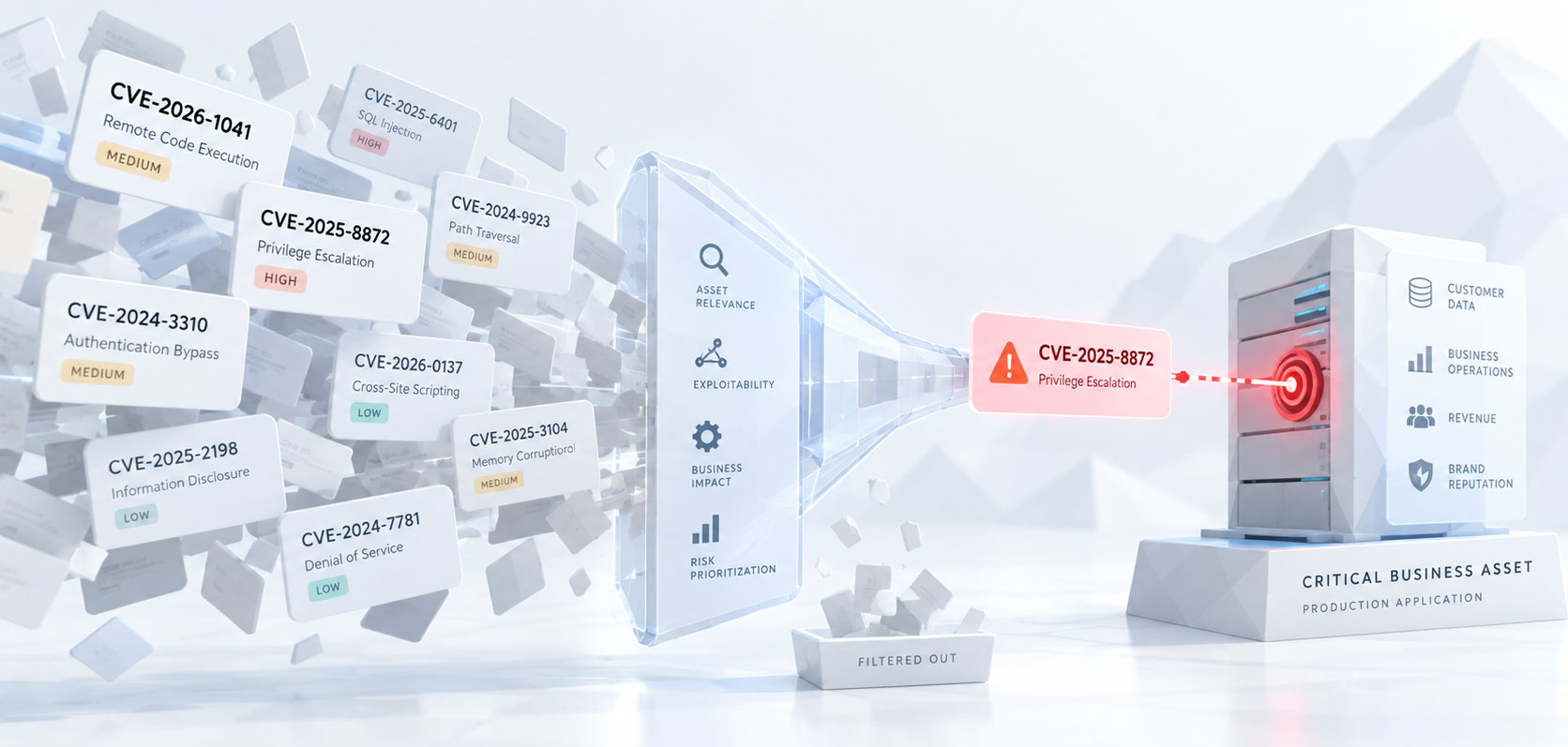
However, simply knowing that a vulnerability exists is not enough. The average time to remediate a critical vulnerability (MTTR) in corporate infrastructure often exceeds 30 days, while attackers often have only a few hours to exploit it. For example, the ShadowServer platform regularly records automated scans and exploitation attempts of new CVEs within the first 24 hours after their publication.
That is why the key to protection today is not patching speed by itself, but a company’s ability to quickly assess risks and prioritize efforts. A Vulnerability Management approach must consider not only the technical severity of a CVE, but also the context: which systems are affected, how critical they are for the business and how likely exploitation is.
Platforms such as Tenable, Rapid7 or Qualys help with this, combined with telemetry from XDR solutions and external Threat Intelligence. Only the combination of these factors allows companies to move from response to true proactive protection.
Attack Surface and Asset Criticality: What You Need to See to Protect
Effective cyber defense is impossible without understanding what exactly needs to be protected. The attack surface of a modern company is no longer just internal servers. It includes remote workstations, cloud services, development environments, API interfaces, IoT devices and much more. Each of these components can become an entry point.
Asset context becomes critical. For example, the same network may contain an ERP system processing financial transactions and a printer. Formally, both may have a vulnerability, but their business criticality is fundamentally different. That is why vulnerability management must consider not just the existence of a problem, but its impact within a specific infrastructure.
For this, CMDB systems such as ServiceNow or BMC, as well as Asset Intelligence platforms, are used. They make it possible to link assets together, understand their roles and dependencies, build an infrastructure map and define priorities.
In today’s reality, it is no longer enough to “check servers once a quarter.” Companies need to continuously scan, analyze relationships and make decisions based on a dynamic understanding of risk. The attack surface is not just a list of IP addresses, but a complex and constantly changing system. Without a complete picture of it, neither protection nor planning is possible.
Risk-Based Prioritization: Why CVSS Is No Longer Enough
Many companies still assess vulnerabilities exclusively by CVSS scores. However, in the context of modern attacks, this is critically insufficient. A high theoretical score does not mean a high probability of exploitation. On the contrary, many CVEs with a CVSS score of 9.8 remain “safe” in a real environment if no working exploits exist for them or if they do not affect important assets.
Real threats require a more dynamic and contextual approach, known as risk-based prioritization. This means evaluating not only the technical complexity of a vulnerability, but also the likelihood of exploitation, asset context, business impact and attacker behavior.
EPSS, Threat Intel and Behavioral Signals in Real Risk Assessment
Exploit Prediction Scoring System (EPSS) is one of the most important steps toward assessing real risk. It is an open model that uses machine learning to analyze hundreds of signals: from the availability of PoC exploits and discussions on the dark web to scanner activity on Shodan or GreyNoise. As a result, EPSS provides the probability of a vulnerability being exploited within the next 30 days.
This probability often differs from CVSS. For example, a CVE with a score of 9.8 may have EPSS <0.01% if it is difficult to exploit and does not interest attackers. At the same time, a vulnerability with a score of 6.5 may be actively used in campaigns and have a high EPSS.
By supplementing EPSS with threat intelligence sources, such as CISA KEV, Cisco Talos and Recorded Future, a company gets the full picture: which vulnerabilities are relevant, are being exploited right now and can cause real damage.
This approach allows teams to focus their efforts on what truly matters: instead of fixing everything at once, they can act precisely and effectively.
Tools and Technologies: How the VM Ecosystem Works in Practice
Vulnerability management is not a single tool, but an entire architecture that combines data collection, risk assessment, visualization, automation and response. Senseti Group helps companies build such an ecosystem based on best-in-class solutions adapted to specific business needs.
An effective VM strategy starts with a reliable scanner, but it does not end there. It includes integrations with XDR, SIEM, patch management platforms and response automation systems to close the full cycle, from detection to vulnerability remediation.
Scanners, XDR, SIEM and Vulnerability Remediation Automation
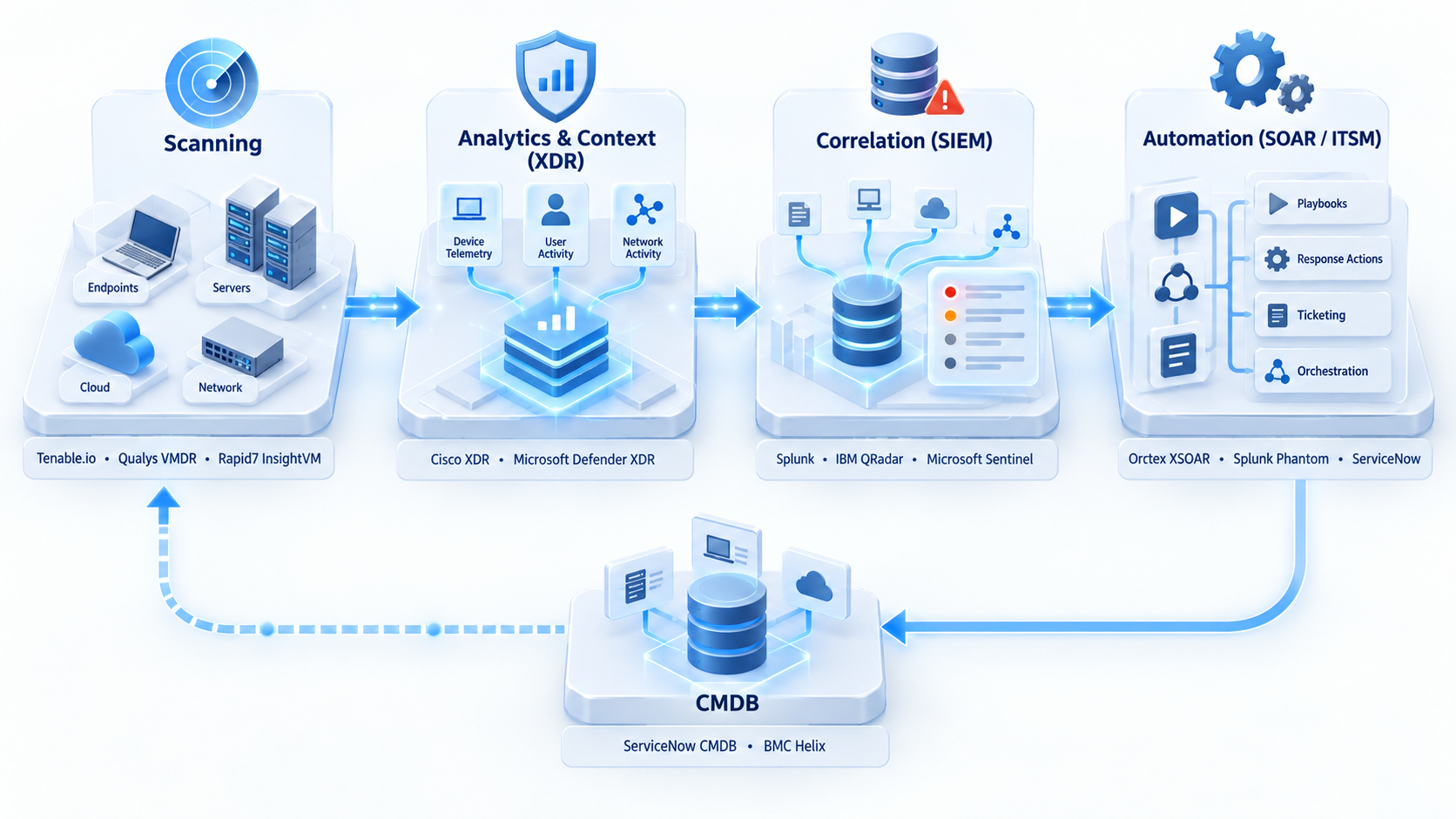
- Scanning, Tenable.io, Qualys VMDR and Rapid7 InsightVM make it possible to detect vulnerabilities at all levels: from cloud environments to endpoints.
- Analytics and context, through integration with XDR platforms, Cisco XDR and Microsoft Defender XDR, telemetry related to user, device and network activity is provided.
- Correlation and alerts, SIEM systems, QRadar, Microsoft Sentinel and Splunk, allow teams to build a complete real-time picture of incidents.
- Response automation, SOAR platforms, Splunk Phantom and Cortex XSOAR, can launch scenarios such as asset isolation, patch deployment and incident creation in ITSM.
In one Senseti case, full automation was implemented: after detecting a critical vulnerability on an asset linked to key business processes, XDR isolates the device, launches the patching procedure and updates the status in CMDB, without human involvement.
This approach reduces MTTR to minutes and allows the risk to be eliminated before an attacker can exploit the vulnerability.
How to Build the Process: From Inventory to Response
Even the best scanners and tools will not deliver results if there is no structured process behind them. Effective vulnerability management is not a one-time activity, but a continuous cycle integrated into IT and business processes. Senseti recommends using a step-by-step framework that covers the entire vulnerability lifecycle, from the moment it is detected to full remediation and retesting.
This approach not only reduces the risk of attacks, but also demonstrates the maturity of security systems during external audits, certifications and communication with regulators.
Vulnerability Management Framework: 6 Implementation Stages
1. Asset inventory
The first step is to get an up-to-date view of the infrastructure: which systems exist, where they are located and who is responsible for them. Tools: CMDB, ITAM platforms, cloud scanners.
2. Vulnerability discovery
Scanning all types of environments: on-premises, cloud, containerized and remote devices. Tenable.io, Qualys and Rapid7 are used.
3. Risk-based prioritization
A combination of CVSS, EPSS, Threat Intel and asset context. Algorithms are used to assess exploitation probability and links to critical business services.
4. Remediation or mitigation
Eliminating the vulnerability, patch, configuration, segmentation, or isolating it, XDR, ACL, privilege reset. Ideally, automated through SOAR or ITSM.
5. Control and audit
Verification that the vulnerability has been remediated. Rescanning, SLA control for fixes and reporting.
6. Continuous adaptation
New assets, new threats, new attack vectors, the process must remain flexible. It is important to regularly review rules, data sources and priorities.
Visually, this process is represented as a continuous improvement cycle, similar to the PDCA model or NIST RMF: it has no endpoint and requires ongoing support and maturity.
What Businesses Can Do Right Now: A Proven Checklist
Companies that are only beginning their journey toward a mature vulnerability management model often face the question: where to start? Senseti recommends using a practical checklist, a set of minimum steps that can be implemented within a few weeks and deliver a tangible effect.
This approach does not require a complete infrastructure rebuild, but it helps quickly identify gaps and start moving toward a more resilient security model.
10 Steps to an Effective VM Process
- Assign a responsible team or process owner. Without a control center, VM remains in a “gray zone” between security and IT.
- Deploy a basic vulnerability scanner. Not only servers, but also clouds, SaaS, workstations and mobile devices.
- Integrate VM with ITSM systems. Creating remediation tickets, SLA control and work in a familiar environment.
- Define your criticality levels. Which vulnerabilities must be remediated within 24 hours and which can be monitored.
- Configure remediation automation. For example, patch deployment or device isolation through XDR + SOAR.
- Define KPIs. Mean time to remediate (MTTR), asset coverage, percentage of remediated critical vulnerabilities.
- Establish communication with business units and leadership. Without business buy-in, the process stalls.
- Audit the attack surface. Which assets are vulnerable, which are critical and where attacks are possible.
- Regularly review priorities. Taking into account new attack vectors and business changes.
- Update processes and tools. The VM market is evolving quickly, it is important to keep pace.
Conclusions: Vulnerability Management as a Strategic Priority
In the context of modern threats, accelerated digitalization and the spread of hybrid work, vulnerability management is no longer a technical task, it is becoming a business priority. Vulnerabilities are not just lines in scanner reports, but real entry points for attacks that can paralyze company operations, compromise data or seriously damage reputation.
A comprehensive approach to VM is about visibility, prioritization, automation and continuous adaptation. The technologies already exist: from risk assessment systems based on EPSS and threat intelligence to automated remediation platforms and attack surface analysis. The key is to build the process properly, adapt tools to the infrastructure and regularly assess the maturity of the approach.
Senseti helps companies go through this journey: from asset audits and VM platform implementation to XDR integration and Zero Trust architecture design. If your organization wants to move from reactive protection to proactive cyber resilience, we are ready to help.