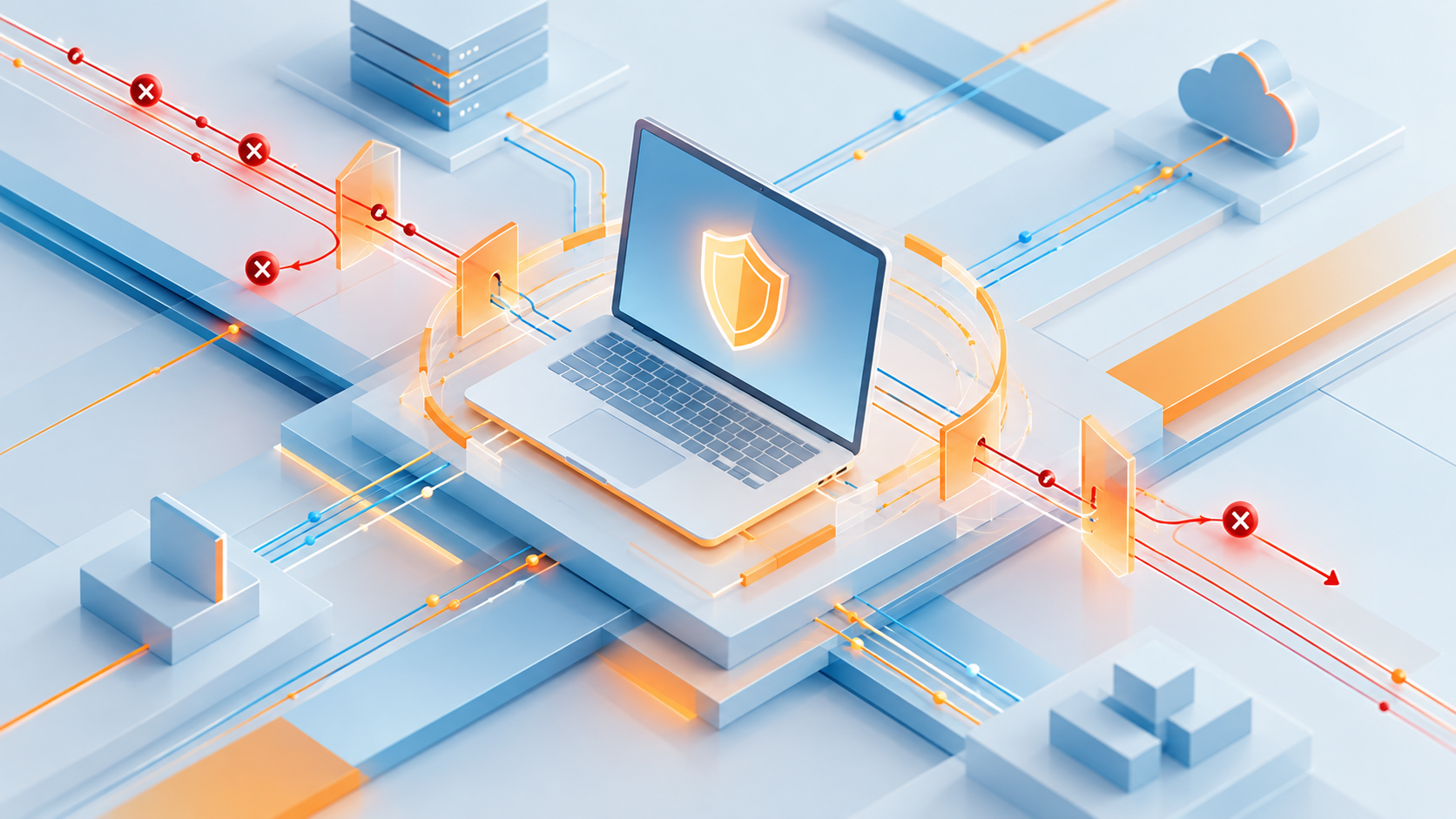





A deep dive into DLP systems: from architecture and operating principles to solution types, use cases and tool selection. We explain how to minimize leak risks, meet regulatory requirements and protect business-critical data in hybrid infrastructure.
What DLP is and why businesses need it

Data Loss Prevention (DLP) is a technology that makes it possible to detect and block attempts at unauthorized transfer of, or access to, mission-critical information in advance. Unlike classic antiviruses or firewalls, DLP focuses not on the threat, but on protecting the data itself, regardless of the attack vector.
Modern DLP systems integrate with network infrastructure, cloud services, endpoints, workstations, and even SIEM and CMDB solutions. They provide visibility into information flows, segment data by confidentiality level and allow security teams to build adaptive protection policies.
For business, this means:
- compliance with regulatory requirements (GDPR, HIPAA, ISO 27001);
- prevention of internal incidents, for example, an employee leaking a client database;
- reduced likelihood of reputational and financial losses in case of an incident.
How DLP works: control layers and response logic
DLP systems operate across several logical layers, controlling the entire data lifecycle: from the moment data is created to its transfer or storage. This makes it possible to configure a precise response to attempts to compromise information, both intentional and accidental.
Three key DLP control layers:
- Data-in-use, protection of data during active use, editing, copying, sending.
- Data-in-motion, monitoring when information is transmitted over the network, email, messengers or API.
- Data-at-rest, analysis of stored data on servers, in the cloud, on workstations.
The system builds policies based on templates: for example, credit card numbers, passport data, internal documentation or contracts. These templates are supplemented with contextual rules: geolocation, action type, user role. Behavioral analysis can also be used, DLP learns to detect deviations from “normal” behavior and respond in real time.
If a violation is detected, DLP can:
- block the action, for example, copying a file to USB;
- notify the security administrator;
- document the incident for the SIEM system.
Integration with SIEM, CMDB and other context sources expands awareness and improves response accuracy without an excessive number of false positives.
What exactly DLP controls: real data leak scenarios
A DLP system can protect data in a wide range of practical situations where employees, accidentally or intentionally, become a leak channel. Examples:
- Sending an email with an attachment, DLP analyzes the content of emails and attachments and can block sending if the message contains contract numbers or personal data.
- Saving to a flash drive, the system can completely prohibit the use of removable media or allow only encrypted writing.
- Uploading to the cloud, if an employee tries to upload a document to Dropbox or Google Drive, the system detects a policy mismatch and prevents the transfer.
- Copying to the clipboard, attempts to copy sensitive information can be automatically recorded and blocked.
- Screenshots or screen recording, advanced solutions can even detect visual screen captures and treat them as a threat.
These scenarios help build a clear control perimeter while preserving flexibility and business process continuity.

Types of DLP systems: endpoint, network, hybrid
The modern market offers three main categories of DLP systems, each differing in its approach to data monitoring and protection: Endpoint DLP, network or gateway-based DLP, and hybrid Enterprise DLP solutions. The right type depends on the infrastructure, business processes, data criticality and the maturity level of the company’s security strategy.
- Endpoint DLP, or host-based systems, are installed on endpoint devices: workstations, laptops and mobile devices. They make it possible to control user actions: copying, printing, screenshots and file sending. This is one of the most effective ways to counter insider threats.
- Network or gateway DLP is deployed at the gateway level, where all network traffic passes through: web, email, FTP and cloud services. This approach is especially relevant for controlling Data-in-motion, meaning data being transferred outside the company perimeter.
- Hybrid DLP combines the capabilities of endpoint and gateway solutions. It provides full control, from employee behavior to network anomalies, and is suitable for organizations with distributed infrastructure, remote offices, clouds and external services.
It is also important to consider:
- Cost of ownership, gateway solutions are easier to scale but may be more expensive at the start.
- Incident detection accuracy, higher at the host level due to local action analysis.
- Administration, hybrid platforms require a centralized console and well-configured policies.
Endpoint or network DLP, which one to choose?
The right model depends on the size of the company, the IT infrastructure in use and the maturity level of information security.
- Small and medium-sized businesses (SMB) most often limit themselves to endpoint DLP. These solutions provide precise control on employee devices without the need for complex network infrastructure deployment. This is convenient if you want to quickly close risks related to copying, removable media and cloud leaks.
- Medium and large enterprises use network or hybrid models because they need continuous control over all channels: email, internet, VPN, API and cloud environments. Gateway DLP is useful for protecting critical services located in a data center or in public clouds.
Network DLP is easier to scale, but it may miss device-level actions if it is not combined with an endpoint solution. That is why, in practice, a combined approach is increasingly used, for example, gateway DLP for traffic control and endpoint DLP for managing user actions.
DLP tools and platforms: overview of market leaders
There are many DLP solutions on the market, differing in architecture, functionality, cost and integration capabilities. Key players include:
- Forcepoint DLP, a strong system with advanced behavioral analysis, deep policies and the ability to protect cloud and hybrid environments. It supports comprehensive audit, reporting and automated response.
- Symantec DLP (Broadcom), one of the most powerful platforms in the enterprise market. It supports detailed data classification, endpoint and network gateway protection, and advanced compliance reporting (GDPR, HIPAA).
- Trellix DLP, a solution from one of the leaders in information security, integrates well with other Trellix products and SIEM solutions. The focus is on analytics and adaptive threat detection.
- Digital Guardian, specializes in intellectual property protection. It offers high accuracy and employee behavior control, especially effective for legal, engineering and R&D companies.
Many of these platforms support different deployment scenarios:
- On-premises, for companies with strict requirements for local protection;
- SaaS / Cloud, fast start, scalability, minimal infrastructure costs;
- Hybrid format, combines local agents and cloud consoles.
What makes Forcepoint DLP different and where it works best
Forcepoint DLP is one of the most powerful and flexible platforms on the market, designed for comprehensive protection of sensitive data in both traditional and hybrid IT infrastructures. The solution is suitable for the corporate sector as well as regulated industries, including finance, healthcare and telecom.
Key features of Forcepoint DLP:
- Behavioral analytics and user risk profiling, the system tracks anomalies in employee actions and adapts security policy to the risk level associated with a specific user or group.
- Automatic data classification, allows the system to recognize and label confidential information, financial reports, personal data and projects, even when the format is non-standard.
- Control across all levels, support for Data-in-use, Data-in-motion and Data-at-rest protection, including removable media, email, web and cloud environments, Microsoft 365 and Google Workspace.
- Flexible integration with SIEM systems, CMDB, AD/LDAP and other corporate infrastructure components, which simplifies implementation and automates incident management.
- Powerful reporting mechanisms, Forcepoint generates detailed incident logs, exportable reports, visual charts and violation tracking by employees, channels and data types.
Where Forcepoint DLP is especially effective:
- In organizations with a branched structure, many branches, remote teams and hybrid clouds;
- In sectors with high regulatory pressure, GDPR, HIPAA, PCI DSS, thanks to compliance templates;
- In cases where flexible adaptation of security policies is important without stopping processes, flexible business role exceptions and allowlists;
- For companies that want to use a risk-based approach to access management and incident response.
How to Implement DLP: Stages, Mistakes and Best Practices
Implementing DLP is not about installing software in a single day. It is a strategic process that covers risk assessment, security policies, employee engagement and integration with other cybersecurity tools. Mistakes at the initial stage can lead to false blocking events, security gaps or even resistance from staff. That is why implementation should be carried out step by step.
The first stage involves auditing risks and critical data: what exactly needs to be protected, who works with it, how it is used and where potential leak points may exist. Next, the control perimeter is defined, including email, cloud services, messaging platforms, printing and removable media. Once the perimeter is established, DLP policies are created to determine which actions are prohibited, what activities should be monitored and what alerts need to be generated.
Implementation should always begin with a pilot project, for example within a single department or branch office. This allows the organization to evaluate real-world scenarios, fine-tune templates and conduct user training. After the pilot phase, the system can be scaled, centralized reporting configured and integrations established with SIEM, CMDB and IAM platforms. Employee training is a mandatory step, staff must understand why DLP is being introduced and how it affects daily business processes.

Benefits and Limitations of DLP: Risks That Cannot Be Ignored
DLP systems provide organizations with powerful control over information. They help prevent data leaks, support compliance with regulatory frameworks such as GDPR, HIPAA and ISO/IEC 27001, generate incident reports and manage risk exposure. This is particularly effective in distributed teams and cloud environments where traditional security controls often fall short.
However, the technology also comes with limitations. The most significant challenges include resource consumption, increased load on networks and servers, policy configuration complexity and false positives that can disrupt business operations. If policies and templates are not adapted to specific business processes, the system may interpret normal employee activity as a threat. It is equally important to secure the DLP platform itself, otherwise it can become a new point of failure and vulnerability.
For this reason, integration with SIEM, IAM and other security systems is critical, along with regular policy testing, trigger optimization and employee education. DLP should serve not only as a monitoring tool but as an integral part of a broader information security architecture.
How to Reduce Overhead and Improve DLP Accuracy
One of the primary challenges in operating a DLP solution is reducing false positives while minimizing the burden on networks and administrators. This can be achieved through contextual security policies that take into account user roles, document types, access locations, time of day and behavioral profiles. For example, access to financial documents after 8:00 PM may automatically be considered suspicious.
It is also important to leverage adaptive templates and machine learning capabilities. The system should learn normal behavior patterns and identify anomalies based on deviations from those patterns. Integration with SIEM platforms enables event correlation across multiple sources, providing a clearer understanding of context and improving decision-making accuracy. Regular policy tuning, sensitivity label adjustments, tagging updates and exception management are all essential for ensuring accurate and non-intrusive DLP operation.
Conclusion: DLP as the Foundation of Modern Information Security
In 2026, data leaks are no longer a hypothetical threat. They are a reality faced by organizations of every size. The cost of a single incident can reach millions of dollars, while the consequences may damage reputation, disrupt business operations and result in regulatory non-compliance.
DLP systems are more than just a tool for preventing data leaks. They are a strategic data governance solution that enables organizations to control who interacts with information, when they access it and how it is used. Modern platforms provide comprehensive coverage, from monitoring user activities to protecting cloud platforms and mobile devices.
However, DLP must not only be technologically advanced but also properly implemented, taking into account business risks, infrastructure requirements and operational specifics. Misconfigured policies, excessive false positives or a lack of employee understanding can significantly reduce effectiveness.
Senseti specializes in implementing information security solutions, including DLP platforms. We can help you:
- Conduct a risk and process assessment;
- Select the optimal platform, on-premises, cloud or hybrid;
- Implement DLP based on your infrastructure and compliance requirements;
- Integrate DLP with SIEM, CMDB and other security systems;
- Train employees and establish an effective incident management framework.
If you want to protect your data, meet regulatory requirements and build a resilient cybersecurity strategy, contact Senseti. We help organizations implement DLP not as a checkbox exercise, but as a fully operational and effective component of business protection.