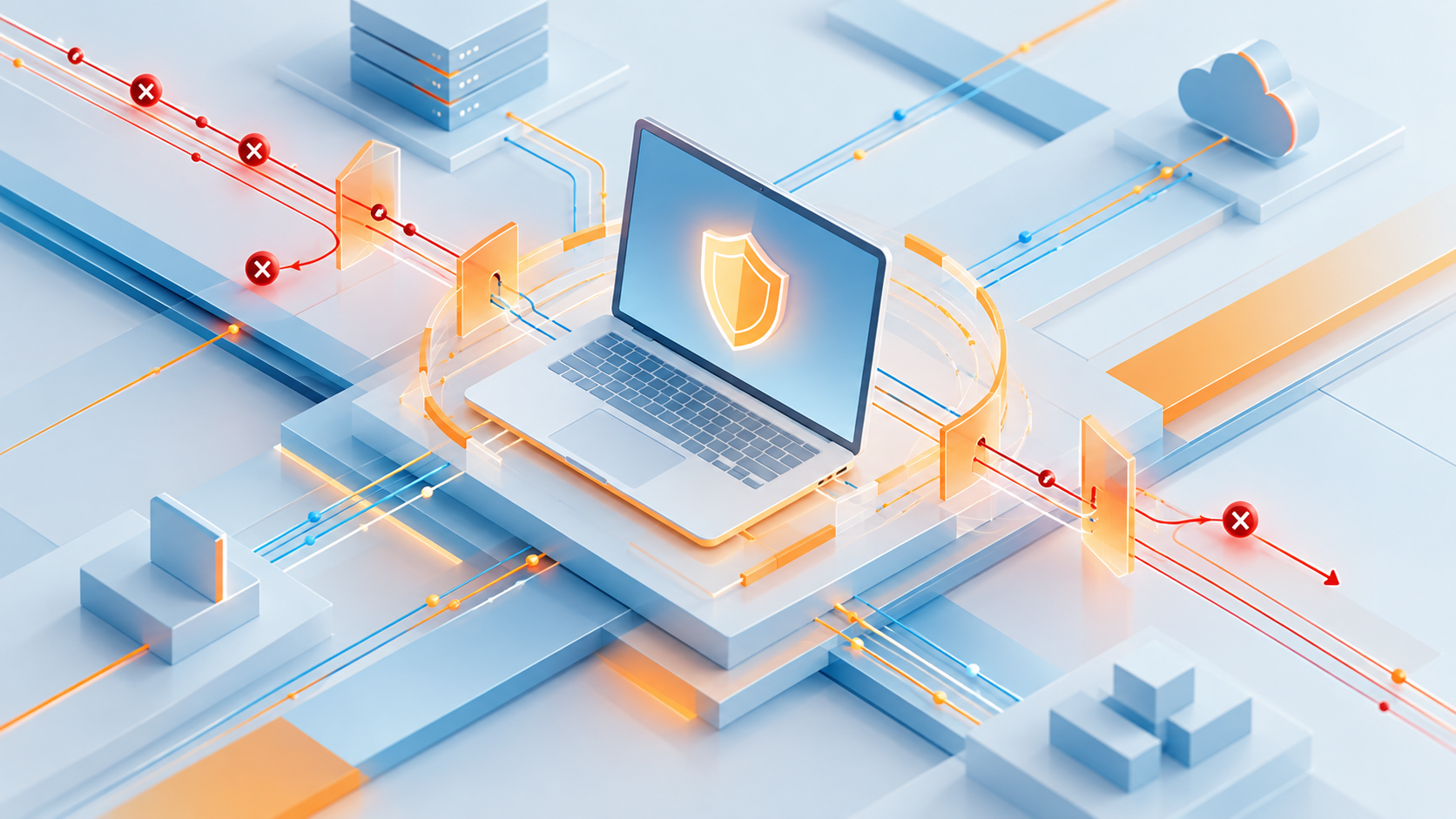





Zero Trust is a modern security approach where neither users nor devices are trusted by default. It includes strict authentication, microsegmentation and continuous control. This approach is especially relevant for cloud and hybrid IT environments.
Introduction: Security Without Implicit Trust
The world is changing, and the approach to information security is changing with it. Over the past five years, companies have faced an exponential increase in threats: attacks have become more complex, and the perimeter has become blurred. Remote work, cloud services, mobile devices and constant interaction with external contractors make traditional security tools less effective.
It used to be assumed that everything inside the corporate network could be considered safe. Today, that approach no longer works. Zero Trust Architecture assumes the opposite: no user, device or application can be trusted by default, even if it is already inside the network. Everything must be verified.
In practice, this means moving from one-time authorization to continuous verification, dynamic access control, microsegmentation and real-time behavior monitoring.
At Senseti Group, we increasingly work with IT infrastructure transformation projects based on Zero Trust principles, especially where the protection of remote users, cloud environments, hybrid systems and sensitive data is critical.
Why the Traditional Security Model Is Outdated and How Zero Trust Replaces It

One of the key challenges is internal data leakage and attacks using legitimate credentials. When an attacker gains access to an employee account, they can move freely across the network, access data and services like a regular user, and often remain unnoticed.
Old approaches still leave companies exposed to common vulnerabilities:
- weak or reused passwords;
- insufficient access rights control;
- “trusted” VPN connections;
- lack of activity monitoring after login.
A practical case: one compromised account with access to an internal file server led to the leakage of tens of thousands of documents, including commercial proposals and internal documentation. And all of this happened without malware, only through valid sessions.
What Zero Trust Architecture Is
Zero Trust is an architecture based on distrust by default. Every request to a resource, every user action and every device connection is treated as a potential threat until proven otherwise.
Put simply, Zero Trust is an approach where every connection is treated as the first one. It does not matter whether the user authenticated an hour ago or just now. The system always checks: who is requesting access, from where, from which device, under what conditions and with what level of risk.
Difference from the traditional approach:
- Traditional model: verification at the entry point and “freedom” inside.
- Zero Trust: verification at every step, continuous control and logging.
Basic Zero Trust workflow:
[Access Request] → [Context and Risk Analysis] → [Authentication and Policy Check] → [Access Granted or Denied] → [Activity Monitoring]
This approach requires not only technology implementation, but also a shift in security culture. It has already become one of the core approaches for organizations focused on resilient cybersecurity.
Key Principles of Zero Trust and How They Work in Practice
Zero Trust Architecture is based on five key principles. Together, they create a new standard for managing access, identity and asset protection in an environment of constant threats.
1. Explicit Verification of Every Action
Every user action must be verified: who the user is, which device they are connected from and in what context they are acting. Identity and access conditions are checked with every request, not only during login. This reduces the risk of stolen devices being used or connections being made through untrusted networks.
2. Least Privilege Access
Each user receives only the permissions required to perform their tasks, nothing more. This approach limits potential damage if an account is compromised and reduces the risk of accidental errors or data leaks.
3. Assume Breach by Default
The security system is built as if compromise has already happened. This means control and monitoring do not stop after a user is authorized. They continue constantly.
4. Full Environment Segmentation
Access to systems and data is divided into isolated segments: there is no “end-to-end” access. Every request is checked separately, regardless of the user’s level. This prevents an attacker from moving across the network even if one segment is successfully compromised.
5. Continuous Monitoring
The system tracks user and device behavior in real time. Any anomalies, such as login from another region, a sudden spike in activity or unusual actions, are recorded and analyzed. All activity is logged and can be reviewed when needed.
Technology Components of Zero Trust Architecture
Implementing Zero Trust requires a complete approach that covers every layer, from identity to monitoring. Below are the core technology blocks that form Zero Trust Architecture.
▸ Identity and Access Management (IAM)
Zero Trust starts by checking “who exactly is requesting access.”
- MFA (Multi-Factor Authentication), protection against password compromise.
- SSO (Single Sign-On), a balance between convenience and security.
- RBAC (Role-Based Access Control), simplified permission management.
- PAM (Privileged Access Management), control over administrator access.
Solutions such as Azure AD, Okta, Keycloak and Auth0 are often used. IAM for developers is becoming an important area as well: integration with CI/CD pipelines, access token management, secrets management and SSH key control.
▸ Network and Device Segmentation
Microsegmentation limits movement inside the network and minimizes the impact of an attack.
- Segmentation at the level of applications, workstations and cloud environments.
- Use of SDN, VLAN and Zero Trust Network Access (ZTNA).
- Flexible routing and filtering based on context: device type, location and risk level.
This is especially important for hybrid environments and multi-cloud architectures.
▸ Endpoint Protection
Computers, smartphones, tablets and other devices become “gateways” into the network.
- EDR/XDR solutions, such as Microsoft Defender, SentinelOne and CrowdStrike.
- Control of user-owned devices (BYOD) through security policies.
- MDM systems for centralized management, such as Intune and Jamf.
The goal is not only protection, but also real-time response: automatically removing a compromised device from the network.
▸ Data Security
Data is the core of the business. Zero Trust limits access and protects data movement.
- DLP (Data Loss Prevention), prevention of data leaks.
- Encryption on devices, in communication channels and in storage.
- DRM and access rights management.
- Access control at the file and document workflow level.
It is also important to monitor actions inside cloud systems, including copying, forwarding and downloading data.
▸ Monitoring and Response
Zero Trust Architecture is impossible without visibility and rapid response systems.
- SIEM (log and event collection), Splunk, Microsoft Sentinel, Elastic.
- SOAR, automation of incident response.
- UEBA, user behavior analytics and anomaly detection.
Incident management in Zero Trust is not just logging. It is rapid risk assessment and action: isolation, notification and blocking.
▸ AI and Automation
Zero Trust scales through artificial intelligence and automated actions.
- Machine learning analyzes user and device behavior.
- AI identifies the “normal” baseline and detects deviations, such as activity spikes or abnormal requests.
- Automated action scenarios include isolation, MFA challenge and administrator notification.
These capabilities are actively developing within ecosystems such as Microsoft Security, Palo Alto Cortex, Cisco XDR and others.
How to Implement Zero Trust: A Roadmap

1. Audit Existing Infrastructure and Security Policies
Assess what resources exist within your infrastructure, how they are protected and who has access to them. Pay particular attention to legacy systems, VPNs, on-premises Active Directory environments and manually managed security policies.
2. Identify Critical Areas and Sensitive Data
Determine what is most valuable for the company: customer databases, accounting systems, source code or personal data. These areas should become the starting point for implementation.
3. Implement IAM Systems (Identity and Access Management)
Deploy Multi-Factor Authentication (MFA), Single Sign-On (SSO), Role-Based Access Control (RBAC) and Privileged Access Management (PAM). This becomes the foundation of trusted identity management.
4. Device Control and Segmentation
Verify that endpoint devices comply with security policies. Configure MDM systems or agent-based policies for BYOD environments. Start network segmentation, especially for high-risk user groups.
5. Employee Training
Even the best architecture becomes vulnerable without awareness. Train teams on secure access practices, handling confidential information and recognizing cyber threats.
6. Integrate Monitoring and SIEM
Deploy a centralized monitoring system. Incidents, anomalies and suspicious activity should be tracked, logged and processed quickly.
7. Continuous Adaptation and “Living” Policy Updates
Zero Trust is not a “set it and forget it” model. Threats evolve, and the architecture must evolve with them. Review access policies regularly, respond to emerging scenarios and continuously adjust configurations.
A note from Senseti Group: We often implement such projects iteratively, starting with the highest-risk areas, for example developer access to production environments, privileged IT administrator accounts or office workstation access to cloud ERP systems.
Examples of Zero Trust Across Industries
Zero Trust Architecture can be applied across a wide range of industries. Below are real-world scenarios where it delivers measurable value:
Financial Sector
- Protection of payment gateways, online banking systems and internal platforms.
- Strict identity verification and access control for financial operations.
- Reduced insider threat risks.
Manufacturing and Industrial Sector
- Separation of IT and OT networks.
- Access control for SCADA, MES and other industrial management systems.
- Segmentation between production lines and office networks.
Retail and E-commerce
- Protection of POS terminals and CRM systems containing customer data.
- Controlled access for suppliers and partners to internal systems.
- Minimized risks when connecting external devices, for example in retail locations.
Healthcare and Pharmaceuticals
- Protection of EMR, PACS and telemedicine systems.
- Segmentation of access between doctors, staff and third-party contractors.
- Encryption and auditing of sensitive medical data usage.
Government Organizations
- Protection against lateral movement within government networks.
- Strict segmentation of critical services such as voting systems or tax databases.
- Compliance with cybersecurity standards and regulations.
Zero Trust as a Strategic Approach: From Security Culture to Architecture
Zero Trust is often perceived as just another product or collection of tools. In reality, it is much more. It is a strategic approach that fundamentally changes the philosophy of information security.
It is impossible to build an effective Zero Trust Architecture if employees continue using the same passwords, sharing credentials through messaging apps or treating security as a formality. Without transforming processes and corporate culture, even the most advanced technologies become ineffective.
For successful implementation, support must extend beyond IT teams. DevOps, management, support teams and end users all need to be involved. Without education, engagement and a clear understanding of why these changes matter, implementation will face resistance and even sabotage. Senseti Group helps customers build this journey step by step, grounded in real processes and actual risks.
Practical Solutions and the Senseti Group Technology Stack
Zero Trust implementation is rarely a one-size-fits-all process. Every company has its own infrastructure, limitations and priorities. That is why we rely on a flexible technology stack tailored individually for each project.
We use mature IAM platforms such as Microsoft Entra ID and Okta, while also implementing lightweight open-source solutions when required by budget or project specifics. For endpoint protection projects, we deploy EDR and XDR solutions such as SentinelOne, Microsoft Defender and FortiEDR depending on infrastructure requirements.
For monitoring, we use Splunk, Elastic and Microsoft Sentinel, with additional SOAR integration for automated incident response. On the network side, we integrate ZTNA solutions such as Zscaler, Cloudflare and Tailscale, delivering secure and flexible access from anywhere in the world.
We do more than configure tools. We design business-driven architectures, audit existing processes, build control chains and create scalable proof-of-concepts.
Common Misconceptions About Zero Trust
When discussing Zero Trust, we frequently encounter the same myths. Many believe Zero Trust is simply another tool or an off-the-shelf solution that can be installed and forgotten. In reality, it is a strategy encompassing architecture, security policy and risk management approaches.
Another common belief is that implementation is too complex and requires enormous budgets. In practice, the model can be introduced gradually, starting with foundational elements such as MFA and segmentation of the most critical environments.
And of course, the myth that “we already have VPN, so we are secure” no longer holds up. A VPN is simply a communication channel, not a security control system.
Zero Trust is equally applicable for startups and large enterprises. The key is understanding your risks and following an implementation path aligned with your business reality.