Hyperconvergence is a new stage in the evolution of IT infrastructure, where compute resources, storage and networks are combined into a single managed system. This approach simplifies management, accelerates scaling and reduces the cost of IT ownership. For business, this means less fragmentation and more focus on strategic tasks.
What Hyperconverged Infrastructure Is and Why Businesses Need It
Modern IT environments are becoming increasingly complex: companies use dozens of applications, hybrid clouds and distributed systems. In this situation, traditional infrastructure models can no longer meet growing requirements for scalability, management and fault tolerance.
Hyperconverged Infrastructure (HCI) combines compute resources, data storage, network functions and management into a single software-defined platform. This makes it possible to centrally manage the entire IT infrastructure through one console and easily scale it as the business grows.
HCI helps companies:
Reduce the number of points of failure and improve resilience;
Simplify infrastructure administration;
Quickly deploy new applications and services;
Reduce operating and capital costs;
Ensure flexibility and adaptability in changing conditions.
Infrastructure Evolution: From Classic Solutions to HCI
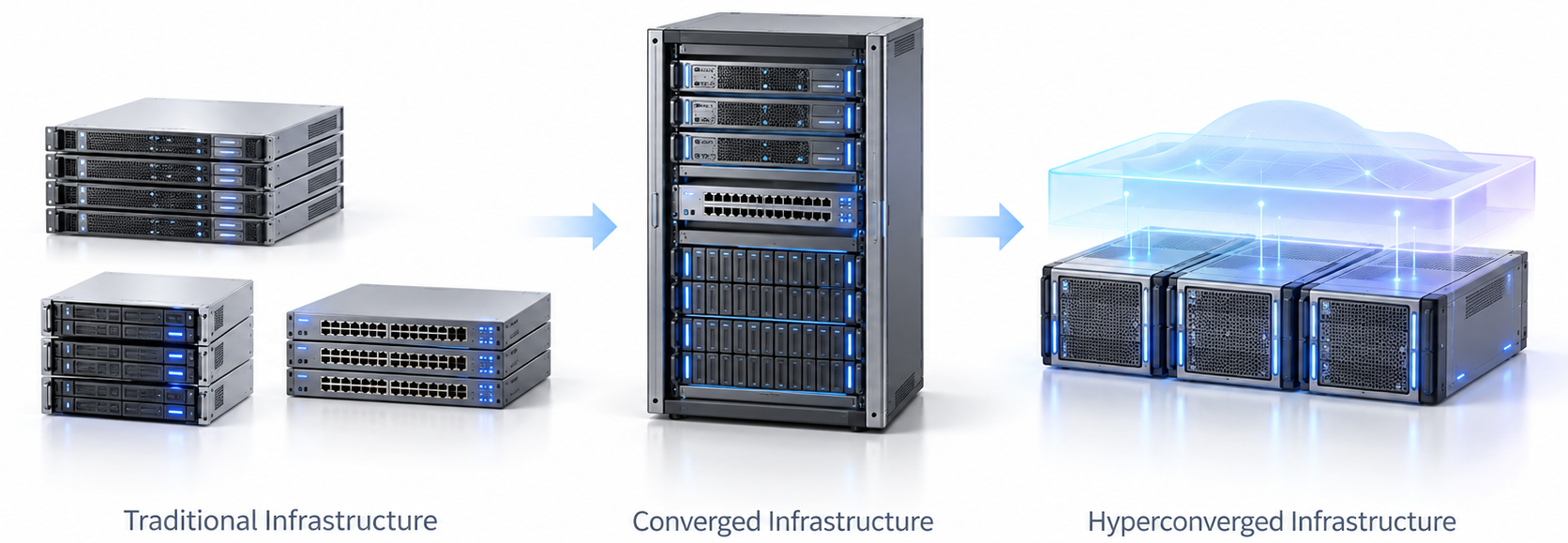
Previously, IT architecture was built according to a classic model: servers, storage and networks existed separately. This complicated management, led to excessive costs and made scaling more difficult.
The converged model introduced component integration into preconfigured modules, but they were still maintained separately. Hyperconvergence went further, components were unified at the software level and began to be managed as a single system.
Thus, HCI became the logical evolution of infrastructure:
from fragmented solutions, to a unified platform;
from complex integrations, to centralized management;
from manual configuration, to automation and orchestration.
Key HCI Components and How They Work Together
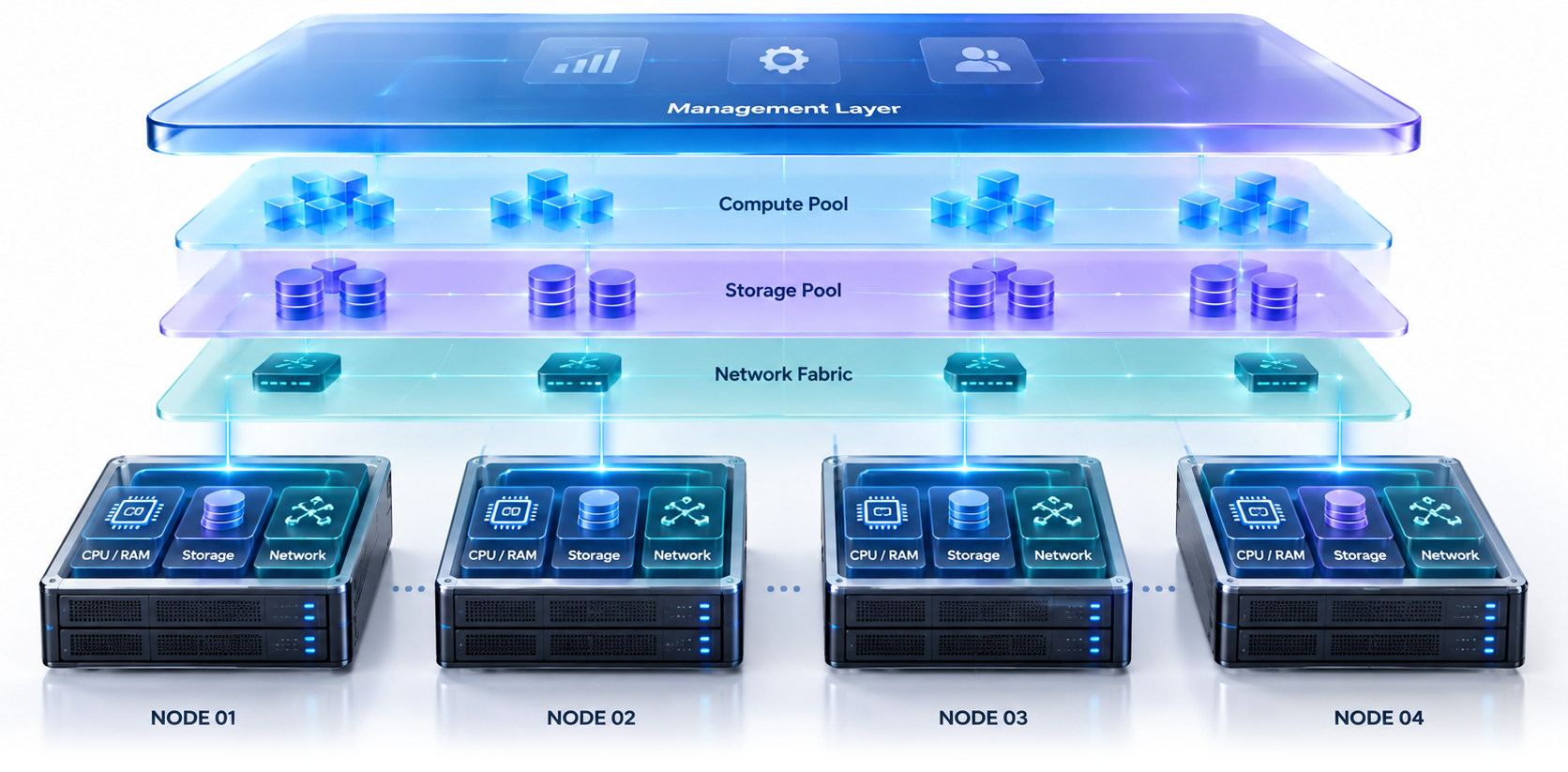
Hyperconverged infrastructure is not just a set of technologies, but a complete architecture where everything works together. The main elements are:
Compute resources (Compute), processors, memory and hypervisors;
Data storage (Storage), scalable, fault-tolerant and often with built-in backup;
Network technologies (Network), virtualized networks and SDN;
Management layer (Management), software for centralized monitoring and automation.
All components are combined into a cluster that functions as a single system. This reduces complexity, improves fault tolerance and simplifies scaling.
A hyperconverged cluster is built on nodes, each of which includes CPU, RAM, local storage and network interfaces. Software combines the resources of all nodes into a shared pool available to all applications.
This architecture provides:
load balancing between nodes;
flexible resource allocation;
automatic recovery in case of failures;
convenient scaling as needed.
The use of SDN and integration with virtualization systems make it possible to create a reliable, predictable and flexible IT infrastructure ready for digital transformation.
Business Benefits of Hyperconvergence
Hyperconverged infrastructure offers companies a fundamentally new level of IT environment maturity. Instead of fragmented components, there is a single platform that scales easily and is managed centrally, reducing the workload on teams and accelerating digital processes.
Moving to HCI allows businesses to focus on strategic tasks by eliminating fragmented IT systems. The infrastructure becomes more predictable, more resilient to failures and easier to support. This is especially relevant for organizations where service launch speed and process continuity are critical to competitiveness.
Where HCI Delivers the Greatest Impact: Performance, Cost Savings and Flexibility
Hyperconvergence delivers the greatest impact in companies with dynamically developing services and high availability requirements. Its benefits are especially visible in the following areas:
Cost reduction, less hardware, lower energy consumption and cooling needs.
Flexible scaling, capacity can be increased without stopping services.
Simplified administration, the entire system is managed through a single console.
Reliability, high fault tolerance at the cluster and data level.
Limitations and Potential Risks of HCI
Despite its significant advantages, hyperconverged infrastructure is not a universal solution for every scenario. When planning a transition, it is important to consider a number of potential limitations, especially those related to scalability, integration and vendor dependency.
Some companies face difficulties when data volumes grow sharply or the architecture becomes more complex. Dependence on a specific vendor may also arise, limiting the choice of technologies in the future. In addition, not all solutions are equally well documented or suitable for specific business requirements.
What to Consider When Choosing and Implementing HCI
Before starting a project, it is important to clearly define requirements for scaling, security and integration with current systems. It is also worth assessing technical support capabilities and staff training in advance. Special attention should be paid to:
Vendor transparency and availability of documentation.
Architecture flexibility as business tasks grow.
The maturity level of the IT team responsible for supporting the new platform.
The possibility of phased implementation without disrupting processes.
HCI vs Cloud: What to Choose and When
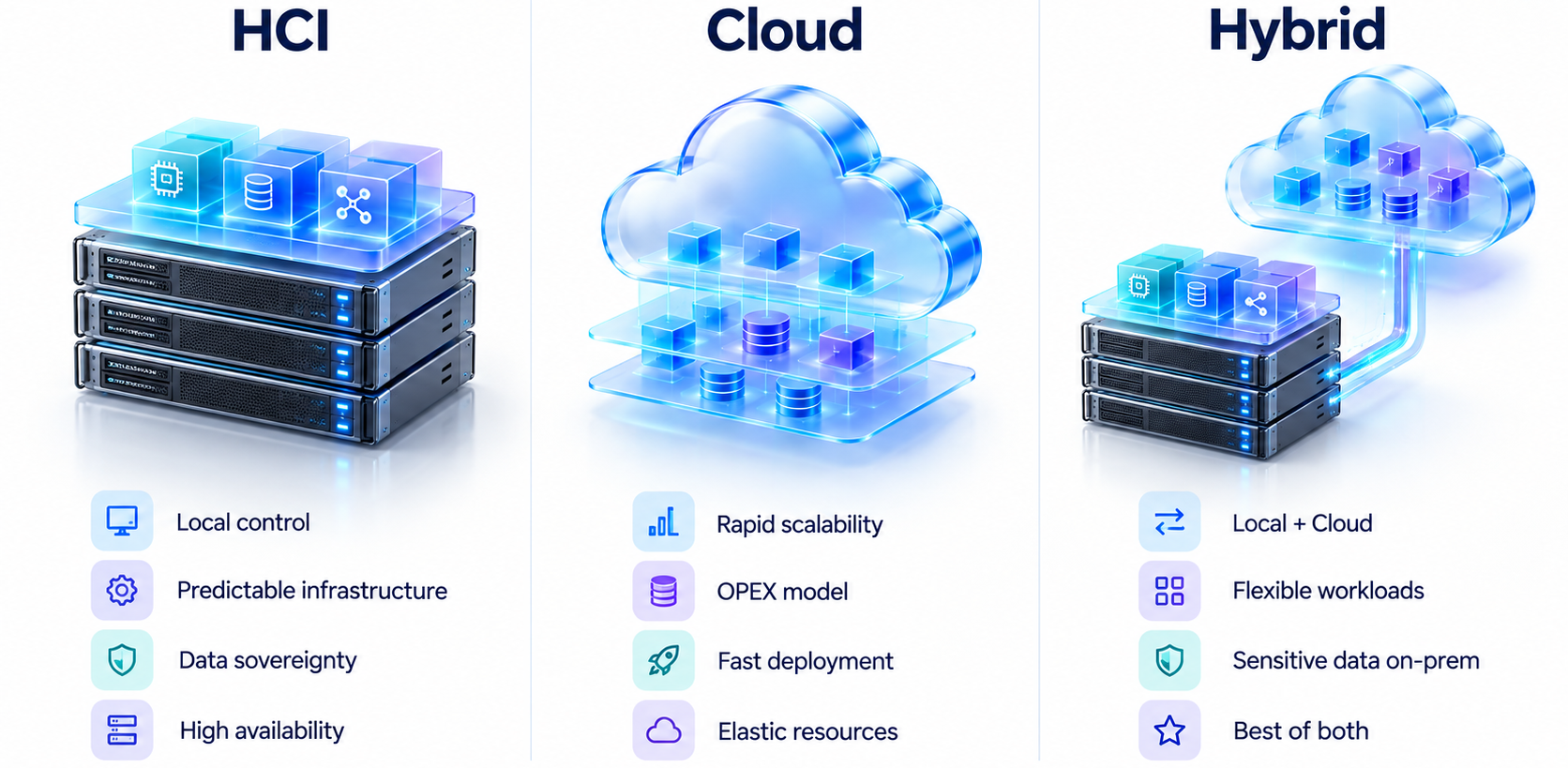
Choosing between hyperconverged and cloud architecture is a strategic decision that depends on business priorities, security requirements, budget and the required level of control over infrastructure. Both models offer scalability and flexibility, but differ in how resources are managed and hosted.
HCI is especially relevant for organizations that need a high degree of control, local data storage and fault tolerance. Cloud solutions provide rapid adaptation to changing conditions, simplified service deployment and reduced spending on physical hardware.
Scenarios: Who HCI Fits, and Who Should Choose the Cloud Model
HCI is suitable for banks, government institutions, telecom operators and manufacturing enterprises where reliability, local control and compliance with regulatory requirements are important.
The cloud model is preferable for digital businesses, startups and organizations with distributed teams, where flexibility and scaling speed play the key role.
Hybrid infrastructure combines the advantages of both approaches, sensitive data remains on the local platform, while scalable services are moved to the cloud.
Senseti Recommendations for HCI Implementation
Implementing hyperconverged infrastructure requires a clear understanding of business goals, technical requirements and the presence of a reliable partner. Senseti offers a comprehensive approach: from assessing the current state of IT to implementing and supporting HCI-based solutions.
We work with proven technologies and vendors, providing clients with architectures that meet modern requirements for scalability, reliability and manageability.
How to Choose a Solution and Partner: The Senseti Approach
When implementing projects, Senseti uses:
Nutanix, an enterprise-grade platform with high flexibility and reliability.
VMware vSAN, a solution for companies using VMware infrastructure.
HPE SimpliVity, an optimal option for consolidating IT infrastructure for medium and large businesses.
Support and infrastructure development after launch.
Conclusions
Hyperconverged infrastructure is not just a replacement for traditional architecture, but a foundation for digital transformation. It combines compute, storage and networking into a single managed environment, simplifying administration and reducing costs.
However, HCI implementation requires careful planning and the right choice of technologies. Senseti helps companies build infrastructure ready for high workloads and rapid change, reliable, flexible and scalable.
Working with Senseti allows organizations to make the most of hyperconvergence, from improving IT efficiency to accelerating business results.
What software-defined networking is: the three SDN layers, the controller, centralized vs decentralized vs hybrid SDN, OpenFlow, key platforms and rollout risks.
What is IT infrastructure and how do you assess your own? Three layers, three types, seven build stages and five quality criteria, from a systems integrator.