How do you design a local area network for business needs? We will look at what LAN consists of, which topologies exist, how to collect requirements, choose an architecture and avoid implementation mistakes. We explain the role of LAN in modern IT infrastructure and its benefits for companies across different industries.
Why Businesses Need a Local Area Network: The Role of LAN in Modern IT Infrastructure
Local area networks (LAN) still remain the foundation of corporate IT infrastructure. Despite the widespread adoption of cloud services and hybrid access models, it is the local network that ensures stable, controlled and secure communication between users, systems and services inside an organization.
For business, this means:
reliable and high-speed data transfer between departments;
centralized access to internal applications, databases and IT services;
support for real-time work, video communication, telephony and messaging systems;
the ability to connect branches, remote offices, warehouses and retail locations into a single IT environment;
stronger security control through segmentation, access policies and monitoring.
In the context of large-scale digitalization, the local network plays a key role in ensuring process continuity, stable operation of internal systems and protection of business-critical information.
Use Cases and Business Tasks Solved by LAN
Across different industries, LAN helps solve specialized tasks. In retail, it supports the operation of POS terminals, video surveillance systems and inventory tracking. In banking, it is critical for payment gateways, internal systems and self-service terminals. In manufacturing, it serves as the infrastructure for equipment control, telemetry collection, process monitoring and controller connectivity.
The overall task of LAN is to become a reliable, manageable and secure environment for all critical processes, both at the head office and across the company’s distributed structure.
What a Local Area Network Consists Of: Components and Interaction
A modern local area network is a coordinated set of hardware, software and architectural solutions that ensure data exchange, resource management and access to business applications.
The basic LAN structure includes:
user devices, workstations, laptops, terminals;
active network equipment, switches, routers, access points;
servers, data centers and data storage systems;
software tools for management, security and monitoring.
The network architecture, both physical and logical, plays the main role. At the physical level, this includes how devices are connected, the cable structure, node placement and the type of network equipment. At the logical level, it includes VLAN systems, routing, access control, traffic prioritization and security policies.
The use of next-generation solutions, software-defined networks (SDN), controllers, orchestrators and automated management platforms, provides flexibility, scalability and security without increasing the administrative burden.
Architecture: How Devices and Services Are Connected
A modern LAN is usually built using a multi-level model: access layer, aggregation layer, network core. This makes it possible to isolate failures, scale infrastructure without stopping business operations and build fault-tolerant scenarios.
Segmentation with VLAN helps separate traffic between different departments or services. At the same time, network layers are connected to centralized management platforms, such as Cisco DNA Center and Aruba Central, which makes it possible to quickly detect anomalies, update configurations, implement security policies and monitor performance in real time.
Designing a Local Area Network: From Business Tasks to Technical Solution
Successful IT infrastructure always starts with high-quality design. A local area network cannot be universal, it must reflect the specifics of business processes, take into account real and future needs, and meet requirements for security, compliance and performance. That is why, at the initial stage, it is critically important to conduct an audit and analysis so the network works stably, securely and scalably.
LAN design begins with formalizing goals: how many users and devices will be connected, which types of applications will be used, which services require high availability or traffic prioritization. At this stage, it is determined where access points are needed, which areas require enhanced protection, and which segments need channel and capacity redundancy.
After that, technical parameters are formed: channel bandwidth, fault tolerance requirements, redundancy options, scaling scenarios, integration with external services and security systems.
How to Collect Requirements: Bandwidth, Growth, Security
The first step is understanding current and projected load. The number of employees and workstations, the volume of transmitted data, the use of video communication, storage and high-access-intensity applications, all these factors influence equipment selection and channel bandwidth.
The second step is scalability. If the business plans to expand, it is important to provide the ability to add new segments without fully reconfiguring the network.
And finally, security. LAN must support requirements for access control, logging, segmentation and traffic protection. In highly regulated industries, finance, telecom and healthcare, special attention is paid to compliance with standards, such as ISO/IEC 27001 and PCI DSS.
Network Topologies: How to Choose the Right Architecture for Your LAN
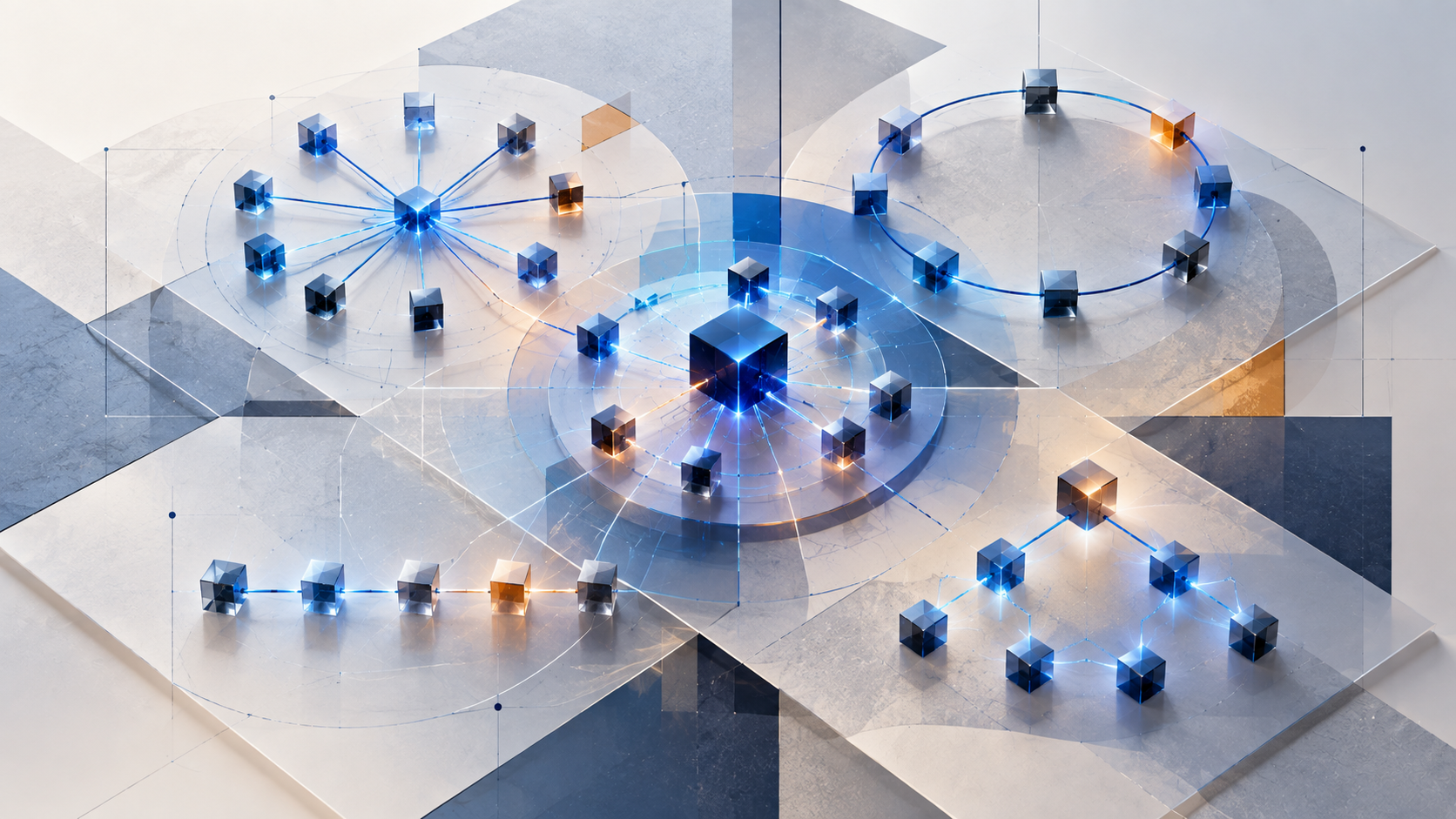
Network topologies define how devices within a local area network are physically and logically connected. The selected structure impacts not only connection stability, but also scalability, manageability, response time during failures, and the overall total cost of ownership of the infrastructure.
The most common topology models include:
"Star", each device connects to a central switch. Easy to administer, suitable for small and medium-sized offices.
"Ring", devices are connected sequentially, and data is transmitted in a circle. Provides balanced load distribution but is vulnerable to points of failure.
"Bus", all devices are connected to a shared channel. Rarely used due to limitations in scalability and reliability.
"Tree", a hierarchical structure suitable for large organizations, allowing clear separation of access levels.
Each topology comes with its own strengths and limitations, and real-world enterprise environments often rely on hybrid approaches that combine elements from multiple models.
Examples and Use Cases: When a Hybrid Topology Makes Sense
Manufacturing companies frequently use a “tree + star” architecture, where core services are centralized while production sites or workshops operate within dedicated subnets connected through a hierarchical structure. In open-space offices with multiple floors, star topology combined with VLAN segmentation is typically the preferred model.
In distributed enterprise networks, where offices are located across different buildings or cities, hybrid architectures are commonly deployed using MPLS, SD-WAN, and backup VPN channels, while the internal LAN maintains a traditional hierarchical structure.
The choice of topology always depends on building architecture, business workflows, and long-term growth plans. A properly designed topology reduces operational costs and improves the fault tolerance of the entire IT infrastructure.
LAN Management and Maintenance: Tools and Best Practices
Effective LAN management is essential for maintaining the stability of the entire IT environment. Without proper visibility and control, the risk of downtime, incidents, and data loss increases significantly. To minimize these risks, modern organizations implement comprehensive approaches to monitoring, updates, redundancy, and access management.
The network must remain fully visible to the IT team: traffic behavior, equipment health, and user activity all help administrators quickly identify issues and respond to threats. Regular security updates, patch management, and well-defined disaster recovery procedures are equally important.
Access segmentation also plays a critical role. NAC systems (Network Access Control) help restrict user and device permissions, reducing the likelihood of internal security breaches. These measures are not one-time actions, but part of an ongoing operational process.
Which Solutions to Use: From Monitoring to Automation
Senseti uses proven technologies that cover all aspects of LAN management. Zabbix and SolarWinds provide real-time network monitoring, helping detect failures and performance anomalies. Cisco Prime and FortiManager enable centralized management of configurations, security policies, and network equipment settings.
To strengthen network protection, IDS/IPS systems such as Snort monitor suspicious traffic activity. Integration with SIEM platforms, including Splunk and QRadar, helps centralize event analysis and accelerate incident response. Patch management can also be automated through update management systems, reducing the workload on IT teams and accelerating vulnerability remediation.
Senseti Recommendations for LAN Deployment and Modernization
Building or upgrading a local area network requires a comprehensive approach. In many cases, LAN issues are not caused by hardware limitations, but by architectural mistakes, lack of scalability, or insufficient security measures. Senseti applies a structured methodology that helps organizations create reliable and adaptive infrastructures capable of growing alongside the business.
It is important not only to deploy the right equipment, but also to integrate it correctly into the broader IT ecosystem. Design flaws, underestimated workloads, and outdated or excessive solutions can significantly reduce both efficiency and security.
Where to Start and What to Focus On: The Senseti Deployment Methodology
LAN deployment based on the Senseti methodology begins with a deep audit of the existing infrastructure. This helps identify weak points, outdated components, and actual workload demands. The next stage involves selecting the appropriate architecture: star, tree, or hybrid topology. At this point, requirements for security, scalability, and fault tolerance are carefully evaluated.
Hardware selection is based on trusted vendors and enterprise-grade solutions, including Cisco, HPE Aruba, Fortinet, and Ubiquiti. During implementation, the Senseti team handles deployment, configuration, testing, and integration of all infrastructure components. The final stage includes continuous support: regular monitoring, updates, technical maintenance, and architectural optimization consulting.
This approach ensures that the local network does more than simply “function”, it becomes a reliable and secure foundation for all digital business operations.
Conclusion
Local area networks remain one of the most critical elements of corporate IT infrastructure despite the rapid growth of cloud and hybrid models. LAN provides the reliable foundation required for internal communication, access control, critical data processing, and uninterrupted operation of business applications 24/7. When properly designed, a local network can deliver scalability, fault tolerance, and compliance with strict security requirements.
At the same time, LAN efficiency depends directly on its architecture, implementation quality, and maintenance strategy. Without systematic monitoring, regular updates, and incident management, even the most advanced network can become vulnerable. Solutions such as Zabbix, Cisco, Fortinet, along with integrations with SIEM platforms and NAC systems, allow organizations to build flexible and secure environments capable of adapting to evolving business demands.
Senseti delivers more than technical implementation. The company acts as a strategic partner in the development and evolution of enterprise network infrastructure. By considering both current business objectives and future growth plans, Senseti combines a systematic approach, proven technologies, and hands-on deployment expertise to create efficient, secure, and future-ready IT networks.
What software-defined networking is: the three SDN layers, the controller, centralized vs decentralized vs hybrid SDN, OpenFlow, key platforms and rollout risks.
What is IT infrastructure and how do you assess your own? Three layers, three types, seven build stages and five quality criteria, from a systems integrator.